
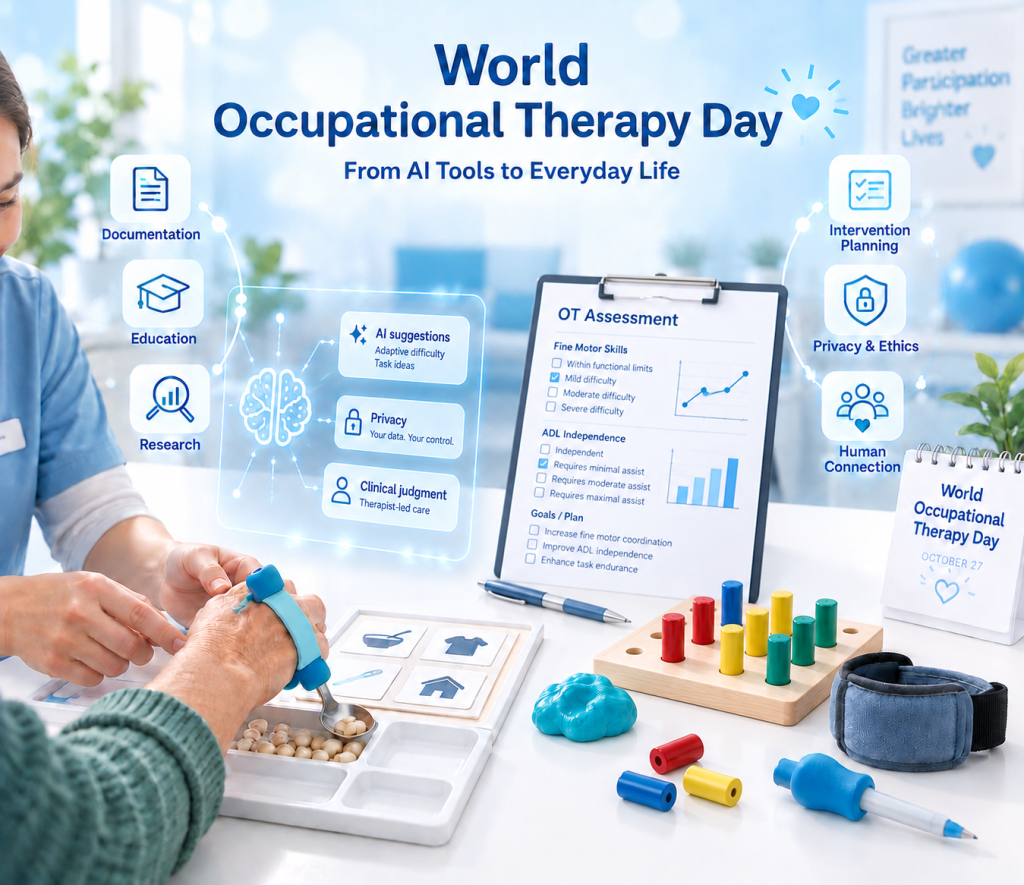
On October 27, World Occupational Therapy Day, occupational therapists are asking an important question: How can artificial intelligence help people do more of what matters in their daily lives? At the WFOT Congress in Bangkok, the WFOT Symposium: Artificial Intelligence took place on February 9, 2026, bringing this question into focus as speakers explored AI’s growing role in the profession. The possibilities are exciting, but technology must support the human connection at the heart of occupational therapy. Its true value will be measured by whether it helps people participate more fully in the activities that give their lives meaning.
AI is already entering occupational therapy workflows. A worldwide survey of 884 respondents across 81 countries found that 56.3% used AI at work and 68.4% viewed its integration positively. Common applications included documentation, administration, education, research, intervention planning, and communication. Respondents also raised concerns about equity, implementation, and professional ethics. These findings indicate growing adoption, although the online survey should not be taken as representative of every occupational therapist worldwide (Cason et al., 2026).
Recent studies illustrate both AI’s potential and the questions that remain. A small randomized trial found improved handwriting among children at risk for developmental coordination disorder after an AI-supported occupational therapy program (Demirci et al., 2025). In a study of 30 adults, an AI-administered initial assessment was considered usable, but most participants preferred the human-led assessment, particularly for compassion and satisfaction (Teng et al., 2026). Reviews describe possible uses of AI with movement analysis, sensors, robotics, and virtual reality, while distinguishing AI-enabled systems from technologies that do not use AI. A scoping review of generative AI in rehabilitation found applications in planning, assessment, education, and clinical reasoning, but limited evidence of patient-level benefit (Cha, 2026; El Arab et al., 2026).
Together, these findings point toward a future of more individualized rehabilitation, in which movement data, assessment information, and a person’s goals may help therapists grade tasks or adapt practice. But personalization must remain clinically reasoned: handwriting gains do not alone establish greater classroom participation, and a usable AI assessment does not replace the trust built through human interaction. Artificial intelligence is opening new possibilities for assessment, intervention, and rehabilitation. Whether those possibilities improve everyday function—and for whom—must be tested, not assumed.
For clinical practice, a proportionate approach begins with the occupational need, not the tool. Therapists and organizations can define which tasks AI may support, review outputs before they affect care, protect client information, and ensure that time saved contributes to meaningful interaction or access. When AI materially shapes an assessment or recommendation, transparency supports informed discussion and shared decision-making. Professional education and organizational guidance should develop alongside adoption.
Responsible use also requires attention to data integrity, bias, consent, privacy, and the limits of available evidence. Researchers should report methods clearly, test systems across diverse populations and settings, and evaluate outcomes that matter to clients—not only technical accuracy or convenience. Clinical accountability remains with the professionals and organizations using AI; an algorithm cannot take responsibility for a decision that affects someone’s care.
On World Occupational Therapy Day, the profession can ground innovation in its enduring commitment to meaningful occupation. Future research should establish whether AI-supported care improves function, independence, and participation—and for whom, in which contexts, and at what cost. The greatest achievement will not be replacing what occupational therapists do; it will be helping us deliver more individualized, evidence-informed care that enables people to participate more fully in their daily lives.
References
Cason, J., Gafni-Lachter, L., Richmond, T., Jacobs, K., & World Federation of Occupational Therapists. (2026). Worldwide survey on artificial intelligence in occupational therapy. WORK: A Journal of Prevention, Assessment & Rehabilitation. Advance online publication. https://doi.org/10.1177/10519815261469529
Cha, S.-M. (2026). Generative AI and large language models in rehabilitation: A scoping review. Life, 16(8), 1310. https://doi.org/10.3390/life16081310
Demirci, O., Yilmaz, G. G., & Köse, B. (2025). Artificial intelligence-supported occupational therapy program on handwriting skills in children at risk for developmental coordination disorder: Randomized controlled trial. Research in Developmental Disabilities, 161, 105009. https://doi.org/10.1016/j.ridd.2025.105009
El Arab, R. A., Al Moosa, O. A., Almagharbeh, W. T., Abuadas, F., Abdalla, N., Abdrbo, A., & Hassanein, S. (2026). Artificial intelligence in physical, occupational and neuro-rehabilitation: Clinical effectiveness, prognostic performance, and pre-implementation feasibility—A systematic review. Journal of Medical Systems, 50(1). https://doi.org/10.1007/s10916-026-02400-6
Teng, M. M., Cathcart, H., Grasza, S., Williams, K., Zhang, M., & Jarus, T. (2026). Developing and evaluating a remote, self-administered, AI-powered occupational therapy initial assessment: A crossover randomized controlled trial. WORK: A Journal of Prevention, Assessment & Rehabilitation. Advance online publication. https://doi.org/10.1177/10519815261491275