
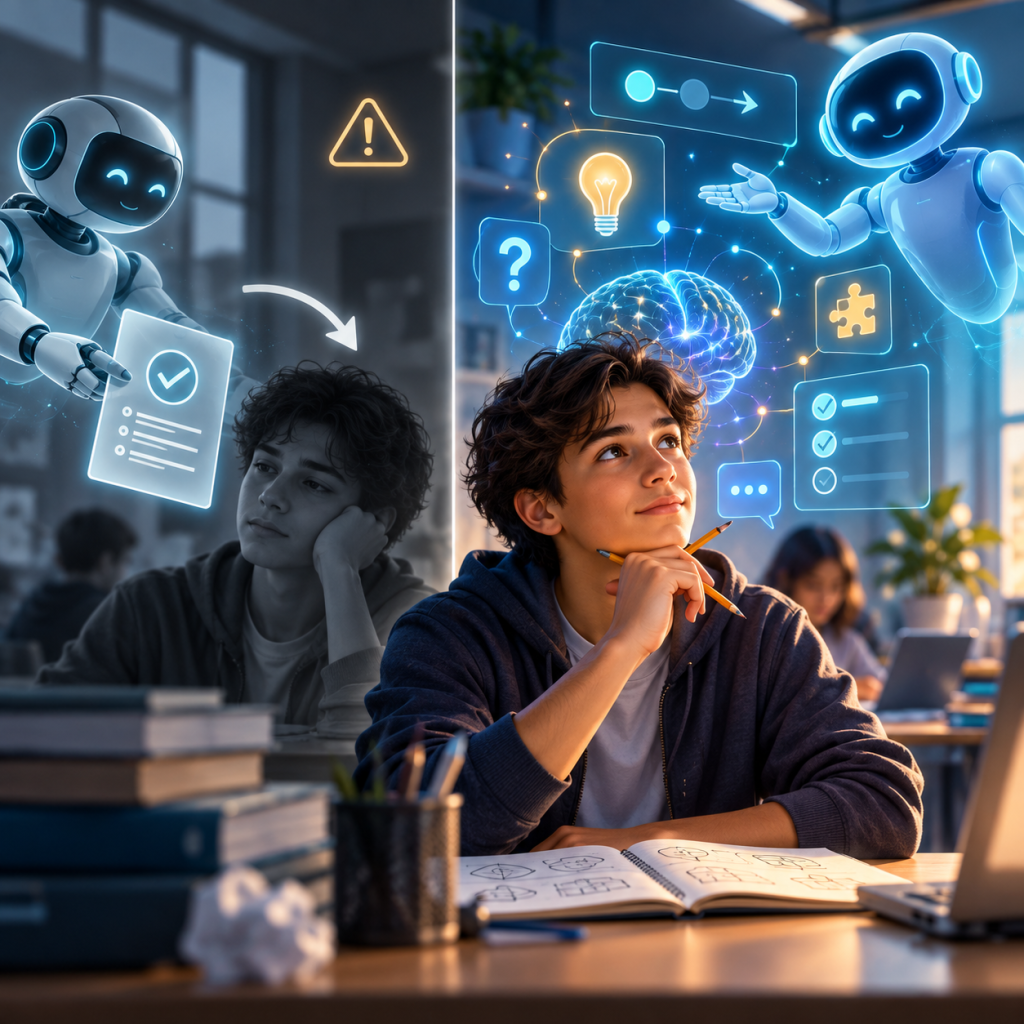
Artificial intelligence (AI) is becoming part of everyday school life. More than half of U.S. teenagers say they use AI chatbots to help with schoolwork. For therapists, educators, and families, the important question is not only whether AI helps students get better grades, but also how it may affect the way they learn, think, and solve problems.
A 2025 study of almost 1,000 high school students found that students using ChatGPT improved their mathematics performance by 48%. However, when ChatGPT was removed, these students performed 17% worse than students who had never used it (Bastani et al., 2025). This suggests that students may complete tasks successfully with AI without fully learning how to do the work independently.
One reason may be cognitive offloading. This means using an outside tool to do part of the thinking for us. People have always used tools such as calculators, calendars, and search engines. These tools can be helpful, but problems may occur when AI does the main thinking instead of supporting the student’s own reasoning.
Young people learn through practice, mistakes, and effort. When students struggle with a difficult problem, they develop skills such as attention, memory, planning, and persistence. If AI immediately provides the answer, students may avoid this important learning process. They may finish the assignment more quickly but remember less afterward.
This does not mean that all struggle is helpful. Students need support when work is too difficult or when they feel overwhelmed. However, some level of effort is necessary for learning. Therapists and educators should therefore help students use AI as a guide, not as a replacement for thinking.
The same study showed that the way AI is designed makes a difference. Students benefited more when the system gave hints and explanations instead of simply providing the final answer. This type of support can encourage students to think, try again, and understand their mistakes. AI should gradually become less necessary as the student becomes more confident.
These issues are especially important for young people with anxiety, attention difficulties, learning disabilities, or low confidence. AI may reduce stress in the short term, but constant dependence on it may make students believe they cannot succeed without technological help. Therapists should therefore ask not only, “Did the student complete the task?” but also, “What did the student understand and what can they do independently?”
AI can still be useful in education and therapy. It may explain difficult ideas in simpler language, provide examples, support organisation, or offer feedback. However, professionals must consider privacy, accuracy, bias, and the possibility that AI may give confident but incorrect information. Human judgment and responsibility must remain central.
The goal should not be to stop young people from using AI. Instead, they need to learn how to use it wisely. Future research should examine the long-term effects of AI on learning, confidence, and independent thinking. Used carefully, AI can support development; used without limits, it may reduce the effort and reflection that real learning requires.
Références
Bastani, H., Bastani, O., Sungu, A., Ge, H., Kabakcı, Ö., & Mariman, R. (2025). Generative AI without guardrails can harm learning: Evidence from high school mathematics. Proceedings of the National Academy of Sciences, 122(26), e2422633122. https://doi.org/10.1073/pnas.2422633122