English

English

When AI Can Listen in Real Time: What New Voice Models May Mean for Clinical Practice

In many therapy settings, listening to a patient’s speech is a key part of understanding their needs. Therapists often record sessions, then spend time later writing notes or analyzing what was said. This process can be slow and sometimes separates the moment of listening from the moment of understanding. New voice-based AI tools are starting to change this by allowing speech to be processed and analyzed as it happens. OpenAI has introduced three new voice models that work in real time. GPT‑Realtime‑2 can hold more natural conversations and respond to more complex questions, using advanced reasoning. GPT‑Realtime‑Translate can translate speech from more than 70 languages into 13 languages while the person is still speaking. GPT‑Realtime‑Whisper can turn speech into written text immediately, without waiting for the speaker to finish. Together, these tools allow developers to create systems that listen, respond, and act during live conversations. For therapists, this may feel like a big change. Instead of only listening and then reflecting later, there is now the possibility of getting support during the session itself. For example, a system could help transcribe what a patient says, highlight important words, or track changes in speech over time. This may make documentation easier and reduce workload, especially in busy clinical environments. However, therapy is not only about words. It also includes tone, emotion, pauses, and the relationship between therapist and patient. While AI can detect some patterns in speech, it does not truly understand the person behind the words. This means that therapists still need to interpret meaning carefully and use their own clinical judgment. The translation model may be especially helpful when working with patients who speak different languages. It can support communication without always needing an interpreter. At the same time, language is complex and shaped by culture. Some meanings, emotions, or expressions may not translate perfectly. Therapists should remain cautious and check understanding when needed. From a practical point of view, these tools can support assessment and intervention. For example, a therapist could notice changes in fluency or word use more quickly. This may help in adjusting treatment plans earlier. It can also support patients practicing at home, especially if feedback is available in real time. At the same time, there are limits. AI systems are trained on large datasets, but they do not include every accent, dialect, or communication style. This means mistakes can happen. The system may misunderstand speech or give suggestions that do not fit the clinical situation. It is important not to rely on these tools without questioning them. For therapists who are still developing their skills, there is a risk of trusting AI too much because it sounds confident. However, good clinical reasoning takes time to build. AI should be used as a support tool, not as a replacement for thinking. Asking questions and reflecting on each case remain essential parts of practice. There are also ethical responsibilities. Patients should know when AI is being used and how their data are handled. Therapists must protect confidentiality and be aware that AI systems can include bias. In the end, the clinician is responsible for decisions, not the technology. Today, your data is like your fingerprint, unique and personal. If your data is used to train AI models, your voice, images, or other personal information could potentially be reused in different forms of content generation. This makes it essential to be careful when choosing which tools to use in clinical settings. Therapists should always check where data is stored, how it is used, and whether it is properly protected. Choosing platforms that prioritize privacy and confidentiality is not optional, it is part of ethical care. Clear consent, secure systems, and informed decision-making should guide the use of any AI tool in practice. Looking ahead, these voice models may become useful tools in everyday practice if used carefully. They can save time and offer helpful insights, but they do not replace human understanding. The role of the therapist remains central. Good care will continue to depend on a balance between using new tools and maintaining strong clinical judgment.

English

Between Technology and Human Care: Understanding the New AI Principles in Speech and Language Therapy

In a typical clinic, a speech and language therapist might use an AI tool to help analyse a child’s speech sample. The tool can quickly suggest patterns or possible goals. This can save time, but it can also feel uncertain. The data may look clear, yet it does not fully show the child’s emotions, intentions, or interaction style. This is where many therapists are now finding themselves, trying to balance useful technology with their own clinical judgment. The new principles from the Royal College of Speech and Language Therapists aim to support therapists in this exact situation. The document was created because AI is developing very quickly, and many therapists are already using it in small ways. Instead of giving strict rules, the principles guide therapists on how to think about AI use. They remind us that AI is a tool, not a decision-maker. Therapists still need to combine research, their own experience, and the needs of each client when making decisions. One helpful way to understand this is to think about two types of thinking. AI often gives fast answers based on patterns. These answers can be helpful, but they are not always complete. Therapists, on the other hand, use slower, more careful thinking. They consider context, the client’s history, and what they observe in the session. The principles encourage therapists to pause and reflect, rather than automatically accepting AI suggestions. AI can be very helpful in daily practice. It can support tasks like writing notes, tracking progress, or suggesting activities. This can reduce workload and give therapists more time to focus on clients. In some settings, especially where services are limited, AI may also help improve access to care. However, these benefits come with challenges. AI tools may not fully understand cultural differences, language diversity, or complex communication needs. Looking at this from other fields, like psychology and neuroscience, reminds us that communication is more than words or scores. It includes relationships, body language, emotions, and context. Two clients may show similar speech patterns but have very different underlying needs. AI may not always recognise these differences. This is why therapist interpretation remains essential. For researchers, AI also brings new questions. It is not enough to show that a tool is accurate. We also need to understand how it affects therapy outcomes, therapist decisions, and client experiences. Research will need to look at real-life use, not just controlled studies. This means working across fields, including technology, clinical practice, and education. In everyday sessions, these principles can act as a guide for reflection. Therapists can ask simple questions: Is this tool helping my understanding? Does it fit this client? Am I still making the final decision? This is especially important in complex cases, where small details in communication matter. AI can support ideas, but it cannot replace the therapist’s full understanding of the person. At the same time, there is a challenge. AI tools often use general data, but therapy must be personalised. Therapists need to adapt what the AI suggests to each individual. This requires not only clinical skill but also confidence in knowing when to question or adjust the tool’s output. The principles support this by reinforcing the therapist’s central role. Ethically, using AI means taking responsibility for how it is used. Therapists need to be open about using AI and make sure clients understand when it is involved. There are also concerns about bias, as AI systems may not represent all populations fairly. In addition, some tools are not fully transparent, which can make it hard to understand how decisions are made. Therapists remain responsible for all clinical decisions, even when AI is involved. Another important point is the therapeutic relationship. Trust, empathy, and connection are key parts of therapy. If therapists rely too much on AI during sessions, this may affect how present they are with clients. The principles remind us that human connection must stay at the centre of practice, even as we use new tools. Overall, the Royal College’s principles do not give final answers, but they offer a helpful starting point. They encourage therapists to stay curious, thoughtful, and responsible when using AI. As technology continues to grow, therapists will play an important role in shaping how it is used in practice. The goal is not to replace human care, but to support it in a safe and meaningful way.

English

When “Bad” Images Are Actually Useful: What a Simple AI Prompt Can Teach Us

In clinical work, we often learn that what looks “perfect” is not always what helps patients most. A recent example from AI highlights this idea in an unexpected way. A new prompt used with an advanced image model (GPT Image 2) asks it to redraw images in a very messy, clumsy style, like something quickly scribbled in MS Paint with a mouse. Surprisingly, the model follows this instruction very well, even though it was designed to create highly realistic, high-quality images. At first, this might seem trivial or even amusing. Why would we want an advanced system to produce something that looks “bad”? But from a clinical perspective, this raises an important point. In therapy, simple, imperfect, or symbolic representations are often more helpful than polished ones. For example, some patients, especially children or individuals with cognitive or language difficulties, find it easier to engage with rough drawings rather than detailed images. The “scribbly” output can feel more approachable and less intimidating. This connects to how people process information. Not everyone thinks in abstract or complex ways. Many individuals understand better through simple, concrete, or visual forms. In that sense, asking an AI to “lower” its quality is not really making it worse, it is making it more flexible and better suited to different needs. The value lies in the match between the tool and the person, not in technical perfection. What is particularly interesting about GPT Image 2 is that it follows instructions very closely. Earlier AI systems often tried to “improve” results automatically, even when asked not to. They would clean up images or make them more realistic, ignoring the user’s intention. This could be frustrating. In contrast, this newer model respects the prompt more precisely. It does what it is told, even if that means producing something intentionally awkward. For clinicians, this idea is quite familiar. In therapy, we do not always aim for the “best” or most refined response. Instead, we aim for what is most useful for the patient in that moment. A rough sketch, a simple metaphor, or an imperfect explanation can sometimes open more meaningful discussion than something highly polished. In this way, the AI’s behavior reflects a clinically relevant principle: usefulness depends on context. There are also interesting research implications. If we can guide an AI to produce both high-quality and low-quality outputs on demand, we can start to explore how it “understands” images. For example, when creating a messy version of an image, which elements does it keep and which does it distort? This could help us learn more about how the model prioritizes visual information, which may be useful in fields like cognitive science or perception research. At the same time, there are important limitations to consider. A system that follows instructions very closely can also produce misleading or inappropriate outputs if the prompt is unclear or poorly designed. In clinical or educational settings, this could create confusion. For example, a deliberately “bad” image might be misunderstood as an error rather than an intentional choice. This means users need to be thoughtful and clear about how they use these tools. There are also ethical considerations. When using AI in clinical or research contexts, we are responsible for the outputs we generate. We need to be transparent about how images are created and ensure they are not mistaken for real data or accurate representations. Questions of bias and interpretation also remain important. Even a simple or “bad” image is still shaped by the model’s training, which may include hidden assumptions. Overall, this example shows that the real strength of AI is not just in producing perfect results, but in adapting to different instructions and needs. For therapists and clinicians, this flexibility is valuable because it helps us create materials that better match our patients, whether that means detailed visuals or simple, imperfect sketches. Looking ahead, the challenge is to use this flexibility thoughtfully, not only focusing on what AI does best, but also on how it can work in simpler, more human ways, opening new possibilities for practice, teaching, and research. Before closing, try it yourself, this is where it really clicks. Running this prompt gives you a quick, hands-on sense of how strongly the model follows your instructions, even when the goal is to be “bad”: “Redraw the attached image in the most clumsy, scribbly, and utterly pathetic way possible. Use a white background, and make it look like it was drawn in MS Paint with a mouse. It should be vaguely similar but also not really, kind of matching but also off in a confusing, awkward way, with that low-quality pixel-by-pixel feel that really emphasizes how ridiculously bad it is. Actually, you know what, whatever, just draw it however you want.”

English

When AI Helps Too Much: Protecting Clinical Thinking and Professional Confidence

A therapist may use AI to prepare a session plan, write a report, organize observations, or create home-program ideas. This can be very helpful, especially during a busy clinical day. AI can save time, reduce mental load, and give structure when the therapist feels tired or overwhelmed. But there is an important question we need to ask: when AI helps us think faster, are we still feeling confident in our own clinical reasoning? A recent study published in the American Psychological Association’s journal Technology, Mind, and Behavior explored this concern. The study included 1,923 adult participants who used commercial AI tools to complete simulated work tasks. Many participants felt that AI “did most of the thinking,” especially in tasks that required planning, organizing, or sequencing. These participants also reported less confidence in their own independent reasoning and less sense that the ideas belonged to them. For therapists, this finding is important because our work depends on much more than completing tasks. Speech-language therapists, occupational therapists, psychomotor therapists, psychologists, educators, and rehabilitation professionals all use clinical judgment every day. We observe the child or client, understand the context, listen to families, interpret behavior, and adapt our intervention. A session plan is not just a document. It is the result of careful thinking, experience, and human understanding. AI can support this process, but it should not replace it. For example, AI may suggest communication goals for a child, but it cannot fully understand the child’s gestures, motivation, frustration, or relationship with the therapist. It may suggest sensory strategies, but it does not know how the child reacts in the room. It may help organize psychomotor activities, but it cannot feel the child’s movement, rhythm, hesitation, or body awareness. These clinical details still belong to the therapist. The main concern is not using AI. The concern is using it passively. Passive use means accepting AI answers too quickly, without questioning them, adapting them, or comparing them with your own clinical observations. In the study, people who actively changed, challenged, or rejected AI suggestions felt more confident and had a stronger sense of ownership. This means AI may be safer and more useful when we use it as an assistant, not as the final decision-maker. A helpful way to use AI is to think first, then ask AI. For example, before asking AI to write a therapy goal, the therapist can write a short idea independently: What is the main difficulty? What does the child need next? What have I already observed? After that, AI can help improve the wording, offer alternatives, or organize the idea more clearly. In this way, the therapist remains active in the thinking process. This is especially important for students and early-career therapists. Clinical confidence grows through practice: observing, making hypotheses, trying interventions, reflecting, and receiving supervision. If young professionals depend too much on AI too early, they may produce good-looking reports but feel less sure about their own reasoning. Training programs should therefore teach not only how to use AI, but also how to question it, correct it, and remain responsible for clinical decisions. There are also important limits to the current research. The study was correlational, which means it cannot prove that AI directly causes lower confidence. It also used simulated work tasks, not real therapy sessions with real clients and families. More research is needed in clinical settings. We need to understand how AI affects documentation, decision-making, supervision, learning, and client outcomes over time. Ethically, therapists must remain responsible for their work, even when AI is used. AI should not receive private or identifying client information unless the system is secure and approved for that purpose. Therapists should also be transparent about how AI supports their work when needed. Most importantly, clinical decisions must be based on evidence, observation, professional judgment, and the client’s needs, not only on AI-generated suggestions. The future of AI in therapy should not be based on fear, but on careful use. AI can be a valuable tool when it helps therapists think more clearly, save time, and explore different options. But it becomes risky when it makes professionals less engaged in their own reasoning. The goal is not to avoid AI completely. The goal is to use it in a way that protects professional confidence, clinical judgment, and the therapist’s sense of authorship.

English

GPT‑5.5 and the changing edge of clinical work: time, control, and responsibility

In clinics and research labs, the hardest part is often not clinical judgment itself. It is protecting the time and mental space that good judgment needs. Notes pile up, emails and forms multiply, analyses wait for a quiet hour that never comes, and decisions still need to be explained clearly on paper. That is the context where GPT‑5.5 becomes clinically interesting: not as a “flashier” model, but as a workflow shift. OpenAI describes it as quicker to grasp what you mean, better at multi‑step work, and more token‑efficient, which often means faster or cheaper iteration. In practice, “understanding what you’re trying to do” is the difference between an assistant that only rewrites sentences and one that helps protect clinical reasoning under time pressure. Think of a complex intake where trauma history, sleep disruption, substance use, and mood symptoms all compete for explanatory weight. A stronger model can help you keep the narrative coherent, track working hypotheses, and separate observed data from inference. The risk is that coherence can masquerade as truth, pulling us toward premature closure. Token efficiency sounds technical, but it changes behavior because it changes how often we revise. If rewriting a consent form, polishing a supervision email, simplifying discharge instructions, or translating psychoeducation becomes easier, teams will iterate more, which can improve clarity and reduce errors. The flip side is that low friction can invite “scope creep,” where the model gets used for higher‑stakes tasks. When language becomes easy to generate, uncertainty can get flattened into confident prose. A bigger shift companies point to is agentic work, meaning the tool does not only draft text but helps move tasks forward across steps and tools. In research, that can tighten the loop between analysis plans, code, and write‑up. In clinics, it can mean faster first drafts of letters, summaries, and resource guides, but these still require clinician review and sign‑off. The promise is less clerical drag, not replacement of clinical thinking. There is also a quieter team effect. If a tool holds context, tracks dependencies, and proposes next actions, people may offload planning and synthesis, which can help workloads but can also erode safety skills like noticing inconsistencies, challenging assumptions, and spotting what is missing. Better tools do not eliminate bias; they often redistribute it. Polished drafts can trigger automation bias (“it looks vetted”), and early formulations can become sticky through anchoring even when later evidence changes the picture. The practical safeguard is to keep clinical structure visible, even when drafting becomes effortless. It helps to consistently separate facts, interpretations, and decisions, and to repeatedly ask for alternatives: what else could explain this pattern, what would disconfirm it, and what uncertainty remains. In research, the most rigorous use is often method support rather than narrative generation, such as clearer preregistrations, audit trails for data cleaning, and standardized reporting. As capability grows, version control matters more: prompts, intermediate outputs, edits, and final decisions should be traceable for peer review or audit. Ethically, responsibility stays with the clinician or investigator, not the interface. Even if system documents describe safety work, they cannot replace local governance, privacy controls, and rules about what can be uploaded and who signs off on patient‑facing or decision‑relevant content. Transparency means being able to explain what the model touched, what it did not touch, and how outputs were checked. Bias monitoring must stay active, because fluent English can hide uneven errors across culture, disability, literacy, and socioeconomic context, especially in translated or simplified materials. A careful conclusion is restrained. The opportunity is not automated judgment, but better conditions for judgment. If token efficiency buys time and tool support reduces clerical burden, attention can return to formulation quality, alliance, measurement, and methodological rigor. The key question is not whether GPT‑5.5 “works,” but when it improves decisions, how it fails under stress, and what accountability structures keep human reasoning clearly in the driver’s seat.

English

The Fool’s Marathon: AI’s Update Sprint

In April 2026, AI companies released new tools very quickly, almost like running a marathon at sprint speed. This can feel confusing or overwhelming. But the main change is important: these tools are not only “chatbots” anymore. They are becoming work tools that can create things we use every day, handouts, summaries, visuals, forms, and drafts for decisions. The question “Which AI model is best?” usually comes up during real tasks. For example: writing a patient handout that is easy to understand, building a study web page, or testing a new intake form before funding deadlines. The danger is that AI can produce something that looks clean and confident, before we have checked if it is correct. So we need strong clinical habits: be clear about uncertainty, save versions, and double-check with trusted sources and real users. Here are the recent updates people are talking about. OpenAI released ChatGPT Images 2.0 on April 21, 2026, and also published a safety document explaining risks of realistic or misleading images. Anthropic released Claude Opus 4.7 and introduced Claude Design (a “canvas” tool for making visual assets) as a research preview on April 17, 2026. Google released Gemini 3.1 Pro (Preview) on February 19, 2026, and Gemini 3.1 Flash Lite (Preview) on March 3, 2026. Model comparison Model Company Context window Intelligence Index Price (USD / 1M tokens) Output speed (tokens/s) Latency (TTFT, s) GPT-5.5 (xhigh) OpenAI 922k 60 11.25 74 63.19 GPT-5.5 (high) OpenAI 922k 59 11.25 78 28.01 Claude Opus 4.7 (max) Anthropic 1M 57 10.00 48 17.57 Gemini 3.1 Pro (Preview) Google 1M 57 4.50 116 21.53 Gemini 3.1 Flash Lite (Prev) Google 1M 34 0.56 313 5.08 A key shift is that AI now creates “objects we think with.” That means not only text, but also prototypes, slide decks, intake screens, and structured case summaries. These outputs can help a team work faster and collaborate better. But they can also “freeze” early assumptions: if something is easy to generate, it may become easy to test, fund, and deploy, even if it is not the best option clinically. This is why cost and speed matter, not only “how smart” the model seems. Some models may be strong at reasoning but feel slow in real work because they take longer to start responding. In clinic-related workflows, if a tool feels slow, teams often stop using it, even if it is technically better. So what is the “best” model? A practical way to decide is to think about your main risk. If your biggest risk is conceptual or factual mistakes, you might accept higher cost or slower performance, and then add careful human review before anything reaches a client. If your biggest problem is volume (too many notes, forms, translations), a faster and cheaper model can be reasonable, if you use templates, rules, and review steps. The biggest ethical risk starts when AI creates something that looks “finished,” like a polished handout, a slide deck, or a clean user interface. When something looks professional, people trust it more, sometimes too quickly. That is why responsibility stays with humans: say when AI helped, keep track of prompts/versions/sources, and test materials with real users (clients, families, staff). If AI shapes care pathways, then accessibility, language, cultural fit, and data handling become clinical quality issues, not just tech details. The updates will keep coming. The safest stance is not “never use AI,” and not “trust it because it’s new.” It is: generate fast, but interpret slowly. Choose tools based on where errors could cause harm, and place checks exactly where harm would concentrate. If you want to follow updated numbers for price/speed/latency, the comparison source used here is Artificial Analysis’ leaderboard: https://artificialanalysis.ai/leaderboards/models

English

Happy Brain Training Community: Staying Informed, Ethical, and Inspired in the Age of AI

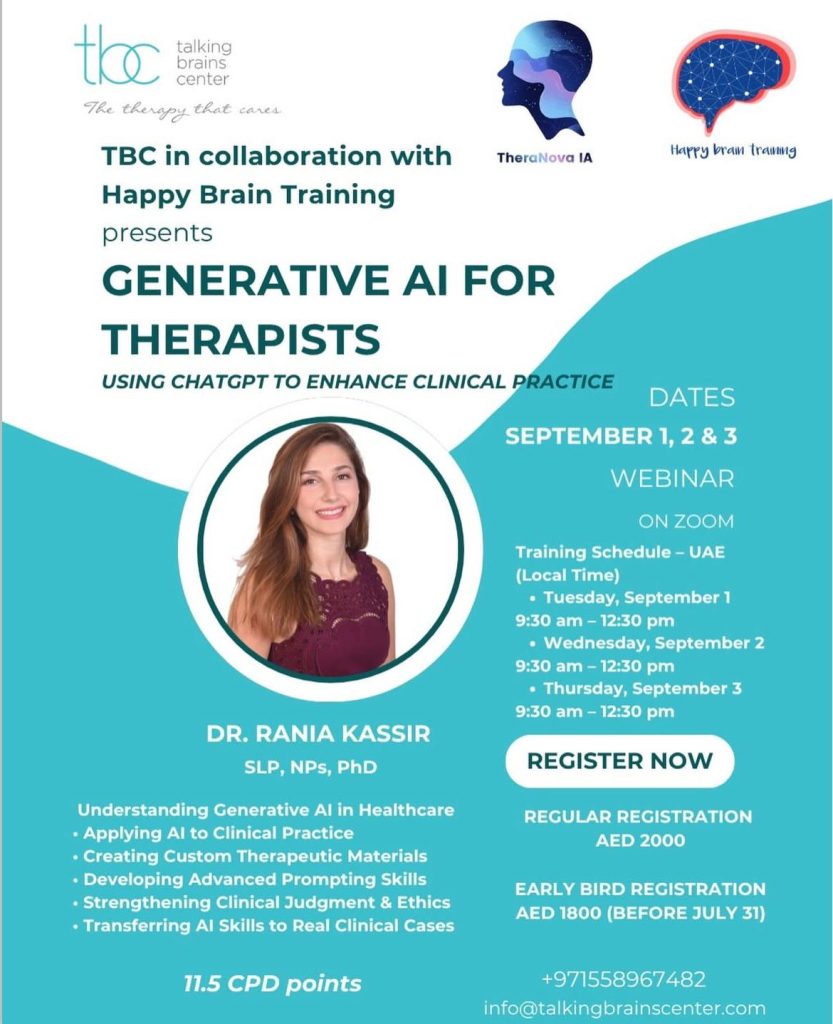
These days, it feels like AI is showing up everywhere at once. A colleague mentions a new note writing tool between sessions, a client quotes something a chatbot told them, and a platform update quietly adds an AI feature you never asked for. In the middle of real clinical work, it can be hard to know what is genuinely useful, what is hype, and what raises ethical red flags. That is why we created the Happy Brain Training Community. It is a free space for all therapists who want to stay updated on the latest in Artificial Intelligence and therapy, without the noise and without the pressure to become a tech expert overnight. We built it the way we would want a professional space to feel. Practical, warm, and realistic about what helps and what does not. Inside the community, we share what actually matters for day to day practice. New AI tools and updates in healthcare, plus innovations that impact therapy in real settings, not just in theory. We also post announcements of upcoming trainings, so you do not have to rely on scattered posts or last minute reminders. It is 100% free, designed to help you stay informed, inspired, and ready for the future of therapy. We are also very intentional about ethics. A helpful tool is not automatically a safe tool, especially when privacy, bias, and clinical responsibility are involved. We keep coming back to the same clinical stance many of us already use in other areas. Slow down, name the risks clearly, and choose safeguards that protect clients and protect our licenses. That ethical lens is consistent with major guidance on responsible AI in health contexts and risk management. Practically, this community is meant to reduce decision fatigue. Instead of each of us reinventing the wheel, we can compare notes on what is working for session planning, psychoeducation, and therapist workflows, while staying clear about what should never be automated. We also make space for the real clinician questions, like how to talk with clients who bring AI generated advice into sessions, or how to set boundaries when a tool feels helpful but ethically fuzzy. One important note. For international reasons, the language of the community is English, so therapists across different countries and systems can actually learn together in one shared space. Our hope is simple and steady: Stay informed. Stay ethical. Stay inspired. If that resonates, we would love to have you with us. Link : https://chat.whatsapp.com/ELZIqaf4eY6C7MoROCPrG7

English

Google’s “JITRO” and the Clinical Logic of Goal-Driven AI: When Systems Stop Waiting to Be Prompted

In clinical research meetings, a recurring tension is becoming hard to ignore: we want automation that reduces error and frees attention for judgment, yet we worry about losing visibility into how decisions are produced. That is the backdrop against which online reporting and commentary about Google’s “JITRO” has been circulating. The core claim is not that this is an update to existing copilots, but a different category of AI, one that does not wait for your prompt because it is organized around goals rather than turns in a chat. In these descriptions, JITRO is framed as an autonomous coding agent built by Google as a next-generation step beyond Jules. The proposed interaction is closer to delegation: you define an outcome, and the system determines the path, intermediate steps, and execution plan. Put simply, it marks a shift from AI as a tool to AI as a self-driving system, with the human role moving from operator to supervisor rather than typist-in-chief. It helps to anchor this in what is officially documented. Google’s Jules is presented as an asynchronous coding agent that can work with a repository in a dedicated cloud environment, propose a plan, implement changes, and then depend on human review before merging. That design choice is not cosmetic; it encodes a safety principle we already rely on in clinical training: autonomy can be useful, but it must be bounded by reviewable work products and accountable sign-off. For clinicians and health researchers, an “autonomous coding agent” becomes relevant as soon as we acknowledge that our evidence base is software-mediated. Trials and service evaluations depend on preprocessing scripts, scoring code, dashboards for adverse events, and versioned analyses that can drift without anyone noticing. A system that can identify what needs to change in a codebase to raise test coverage or lower error rates might strengthen reliability, but it also relocates risk into the infrastructure that operationalizes our methods. The difference from prompt-based tools is not merely speed; it is a change in who performs task decomposition. In a prompt-based workflow, the human breaks the work into steps and continuously steers. In a goal-driven workflow, the system decomposes the work on its own, and you assess the plan, the edits, and the evidence that the goal has been met. Clinically, this resembles the difference between instructing a trainee minute-by-minute and supervising their independent management plan. Human factors research helps explain why this transition can feel deceptively “easy.” As systems move from assisting to acting, the human role often becomes monitoring, an activity that is cognitively demanding and vulnerable to over-trust under time pressure. In clinical decision support, automation bias describes reduced error detection when automated suggestions are present, especially when workflows reward speed. A persistent engineering agent can create an analogous vulnerability: the more competent it appears, the less likely we are to interrogate edge cases. This is why the reported emphasis on approval checkpoints is not a minor implementation detail. The practical issue is whether checkpoints deliver real inspectability, clear plans, test evidence, and an intelligible mapping from goal to code edits, rather than a single yes/no gate at the end. Without legible rationales and meaningful validation, “human-in-the-loop” can become performative, particularly in large codebases where no one can realistically scrutinize everything. Several uncertainties should be stated plainly. “JITRO” itself appears more in informal commentary than in primary technical documentation, so its exact capabilities should be treated as provisional. Still, as a concept it crystallizes a live transition: stop thinking of AI as something you prompt, and start thinking of it as something you give direction to. That reframing can make existing tools more powerful, and also makes goal specification a methodological act, not a convenience. Ethically, goal-driven agents sharpen familiar obligations in clinical and research settings. Responsibility remains with the human team even when the system is the proximate “author” of code changes; transparency must be engineered so decisions are reconstructible; and data integrity depends on governance, testing, and audit trails that detect drift. Risk frameworks emphasize accountability and ongoing monitoring, and those expectations become more, not less, important as autonomy increases. The most constructive stance is neither dismissal nor enthusiasm, but disciplined curiosity: if goal-driven agents are becoming engineering teammates, we need supervision science to match. That includes studying which checkpoint designs actually reduce error, how to quantify drift in agent-modified pipelines, and how to preserve interpretability when plans are generated by systems optimized for throughput. The shift may be underway, but its clinical value will depend on whether outcome-driven automation can be made compatible with methodological rigor and accountable care.

English

A New Cyber Risk in the Therapy Room: Why Project Glasswing Changes the Trust Equation

Cybersecurity isn’t a niche IT problem anymore. It’s a condition of modern life: banking, education, government services, and healthcare all run on fragile layers of software we rarely see. Most people only notice this fragility when something goes wrong—an outage, a breach, a locked account, a system that suddenly can’t be trusted. The risk is broad, but the consequences aren’t evenly distributed. In healthcare, that unevenness is felt fast. When digital systems fail, care doesn’t politely pause until things come back online. People still show up distressed, unsafe, or mid-crisis, and clinicians still have to hold decisions with incomplete information. The “technical incident” becomes a human one, often within minutes. That’s why therapists should care even when the conversation sounds far away from our day-to-day work. In therapy, cybersecurity rarely announces itself as “cyber.” It shows up as a session abruptly canceled because scheduling is down, a telehealth link that fails at the last moment, or a clinic suddenly unable to access notes. It also shows up as a client asking, quietly but directly, whether their messages are truly private. Against that background, Anthropic’s April 7, 2026 announcement of Project Glasswing is more than tech news. They described an unreleased model, Claude Mythos Preview, and emphasized that it will not be made generally available. Instead, it’s being routed through a restricted program, framed around defensive use. When an AI lab decides a model is too capable to release, that’s a signal about where the threat landscape is heading. The key reason given for the lockdown is simple and unsettling: Anthropic presents Mythos Preview as able to find serious vulnerabilities with very little human steering. In plain terms, it can reportedly spot weak points in software faster and more autonomously than earlier systems. Even if the intention is defense, the capability itself matters, because capabilities tend to spread, and because attackers also adapt. Anthropic’s examples are the kind that make non-technical people uneasy for good reason. They highlight weaknesses in widely used foundational software and describe cases where issues persisted for years, even decades, without being caught. That’s the uncomfortable truth about digital infrastructure: many systems we treat as stable are stitched together from codebases with long histories, uneven maintenance, and hidden complexity. If that still feels abstract, bring it back to the tools we actually use. Telehealth platforms rely on browsers, operating systems, servers, and third-party libraries. Scheduling systems and patient portals depend on integrations and APIs that can quietly multiply risk. A vulnerability “somewhere upstream” can become downtime, data exposure, or service disruption right where clients meet care. There’s also a structural question that matters for healthcare: who gets access to the strongest protective tools, and when? Restricting a high-capability model may reduce immediate misuse, but it also concentrates power and expertise in a small set of organizations. Smaller clinics and vendors can end up dependent on security timelines, priorities, and disclosure decisions they can’t easily see or influence. That gap, between ethical expectations and technical realities—can become a trust problem. Practically, this pushes us toward a more explicit, system-level view of clinical risk. We can’t patch operating systems, but we can treat cybersecurity maturity as part of quality of care. That means asking better procurement questions, requiring clear incident response commitments from vendors, and maintaining downtime protocols that protect continuity. It also means reducing “shadow tools” and unmanaged AI add-ons that expand the attack surface without oversight. Ethically, the goal isn’t to panic, it’s to insist on defensible trust. In clinical contexts, “trustworthy” should mean there are decision trails we can explain: what system was used, what data moved, what safeguards existed, what logging and auditing were in place, and how errors or incidents will be corrected and disclosed. Clients shouldn’t have to rely on invisible infrastructure and hope for the best; they deserve care systems built to fail safely. Project Glasswing is a preview of a new phase: AI is not only changing clinical tools, but also changing the security environment those tools sit inside. Patient trust depends on confidentiality, integrity, and availability, and those depend on infrastructure now being stress-tested by increasingly autonomous systems. For therapists, the task is to keep the clinical frame intact as the technical frame accelerates: protect continuity, protect privacy, and advocate for systems we can actually stand behind.

English

When the Model Stays on Your Device: Gemma 4, “Free Forever,” and What Privacy Really Means

In clinic, the friction point is rarely curiosity about AI; it’s governance. A supervisee wants help rewriting a sensitive school report, summarizing an OT evaluation, or drafting a consent form in simpler Arabic, then asks the question we all recognize: “Can I paste the real text?” The ethical discomfort is that most chat systems are cloud-mediated by design, and our default answer becomes a risk-management lecture rather than a clinically useful pathway. That’s why the claim, “Imagine ChatGPT, but installed directly on your device… private, offline, and free,” spreads so quickly. It sounds like the long-promised reconciliation of capability and confidentiality. But slogans are not safeguards, and “CEO energy” is not a clinical governance framework. Even when a tool comes from a major company, brand is not a substitute for evaluating workflows, auditability, and failure modes. What this points to, more precisely, is the growing ecosystem of local-capable models, including Gemma 4, that can be downloaded and run in environments you control. The practical promise is simple: you ask questions, it drafts text, it helps structure documentation, and in some setups it can support image-related work, while computation can happen on your own device. That “where the model runs” detail is not cosmetic; it is the whole privacy story. The “price” point matters for therapists because it changes adoption pressure and boundaries. If a model is “free” to download and run, the barrier shifts from subscription gatekeeping to hardware limits and setup time. You still “pay,” just differently: battery/heat, local storage, occasional troubleshooting, and the need for someone to own maintenance. But the psychological shift is important, capability feels close enough to use in real workflows, not only as a toy. Here is where the comparison belongs, because it sits right inside that workflow decision: you are choosing not only an AI, but a data path. Gemma 4 is one local option, but not the only one; many people also run DeepSeek-style models locally, and others choose Llama, Mistral, or Qwen depending on hardware and licensing comfort. The short comparison is this: local models (Gemma/DeepSeek/Llama/Mistral/Qwen run on-device) can support stricter confidentiality by keeping text in-house, while cloud models (ChatGPT/Claude/Gemini-style) often deliver stronger convenience and scalability but require clearer rules because identifiable data may leave your device unless you have an enterprise-controlled setup. That’s why the phrase “Google sees nothing” is directionally true only under a specific condition: you are actually running it locally. “Local” is not a vibe; it’s an implementation choice—offline runtime, no hidden uploads, and settings you can verify. If you test the model in a browser demo, a hosted notebook, or any web app, you’re no longer in “offline” territory, and you should treat it like any other cloud tool: fine for synthetic or de-identified material, not fine for identifiable documents unless policy explicitly allows it. Clinically, the most defensible value proposition of local inference is not novelty; it is a narrower but meaningful shift in what can be done without exporting identifiable data. Drafting discharge summaries in a consistent format, creating parent-friendly psychoeducation, adapting worksheets across reading levels, or generating structured session-plan templates can reduce administrative load. If the model is truly running offline, these tasks can be done while keeping protected content on the device, closer to the practical spirit of confidentiality, even when policy language lags behind technology. Evidence-based practice pushes a harder question: where does this help clinical reasoning rather than merely accelerate text production? The risk is that fluent output can masquerade as warranted inference, especially in formulations, risk narratives, or “professional-sounding” reports that feel authoritative because they read well. Used well, a local model supports the plumbing of care (formatting, translation drafts, checklists, reflective prompts), while the clinician retains responsibility for interpretation, differential thinking, and the therapeutic relationship. The “no limits” claim also deserves a clinician’s skepticism. Local models are not capped by a subscription counter, but they are constrained by memory, thermals, battery, and model size trade-offs. More importantly, offline does not equal harmless: hallucinations, bias, and overconfidence persist, and sometimes become more insidious when the system feels safe because it is private. Ethically, local AI concentrates accountability rather than dissolving it. If a clinician chooses to process identifiable material on-device, they also inherit responsibilities around device security, app telemetry/logging, model provenance, update hygiene, and documentation of use. Transparency is a workflow discipline: noting when AI assistance was used, what kind of inputs were provided, and how outputs were verified supports data integrity and defensible decision-making. What is most clinically interesting here is not the bravado of “offline intelligence,” but the opening of a more nuanced design space. Small local models for privacy-sensitive drafting; larger systems for literature work under controlled governance; and hybrid approaches that treat AI as an assistant to clinical judgment rather than a proxy for it. The next wave of useful work, worthy of supervision projects and pragmatic trials, is testing whether local inference measurably reduces documentation burden and improves patient comprehension without quietly eroding standards of verification.

Shopping Cart