
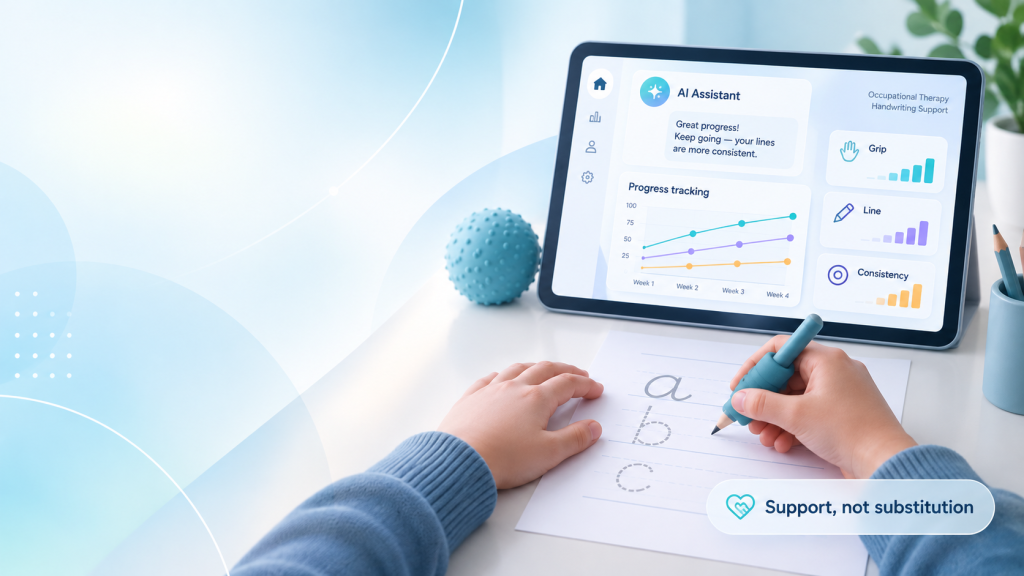
A child with developmental coordination disorder (DCD) may find handwriting, dressing, playing sports, or keeping up with classroom activities difficult. These challenges can affect confidence and participation, not just movement. Occupational therapy focuses on helping children take part in the activities that matter to them, while working with families and schools to make practice useful in everyday life.
One 2025 randomized trial studied an AI-supported occupational therapy program for 42 children aged 8–12 who were at risk of DCD. Children in the intervention group attended therapy twice a week for eight weeks. Their handwriting improved in speed, alignment, size, spacing, shape, and legibility. These findings are encouraging, although the small study does not tell us whether the improvements lasted or transferred to everyday classroom writing (Demirci et al., 2025).
A second study asks whether parents can lead home-based neuromotor practice with support from AI movement analysis. This is a trial protocol, not a report of results. It describes a planned study of 62 children with DCD, comparing conventional physiotherapy with conventional physiotherapy plus a 12-week, parent-led program. Video analysis is intended to estimate aspects of movement, such as coordination, symmetry, and speed. We must wait for the trial results before knowing whether the approach helps (Hullumani & Qureshi, 2026).
Together, the studies point to two possible uses of AI: supporting a specific therapy program, such as handwriting practice, and helping families observe movement during home activities. In simple terms, AI may measure patterns in a video and help track change over time. But a measurement is not the same as understanding a child: camera position, lighting, clothing, and the child’s movement style can affect what the system detects. Results need careful checking.
For occupational therapists, AI could help organize progress information, suggest activities for discussion, and show whether a child’s movement changes with practice. In the future, it may support work on balance, hand skills, planning, attention, or daily routines. These are possibilities to test not benefits we can assume. Therapists must check that AI-generated suggestions fit the child’s goals, abilities, culture, and home or school environment.
Could parents, guided by AI, replace a therapist? AI may help parents practise activities between appointments, but it should not replace professional assessment or individualized care. Parents know their child well and can make practice part of daily life; therapists bring clinical training to interpret difficulties, adapt tasks, and respond when progress stalls or a new concern appears. A parent-led program works best as a partnership, with clear instructions and access to therapist guidance.
The therapist’s role may therefore shift, but it does not disappear. Occupational therapists can set meaningful goals with children and families, guide safe practice, interpret AI-generated information, and adjust plans as needed. They also connect movement gains to everyday participation, such as playing, managing schoolwork, or dressing independently. Therapists must explain AI’s limits, protect children’s data, check for bias, and ensure that clinical decisions remain their responsibility.
The next step: Future research should test whether these programs improve everyday participation, whether benefits last, and whether families can use them comfortably. AI may make practice and monitoring more accessible, especially where therapy services are limited. Its value will depend on keeping the human parts of care at the centre: listening to children, supporting families, and helping each child become more confident and independent.
References
Demirci, O., Guney Yilmaz, G., & Köse, B. (2025). Artificial intelligence-supported occupational therapy program on handwriting skills in children at risk for developmental coordination disorder: Randomized controlled trial. Research in Developmental Disabilities, 161, 105009. https://doi.org/10.1016/j.ridd.2025.105009
Hullumani, S., & Qureshi, I. (2026). Development, validation and effectiveness of a parents led neuromotor training module with AI-based movement analysis for improving motor proficiency and sports participation in children with developmental coordination disorder: A protocol for an assessor-blinded randomized superiority controlled trial. Frontiers in Human Neuroscience, 20, 1931622. https://doi.org/10.3389/fnhum.2026.1931622