
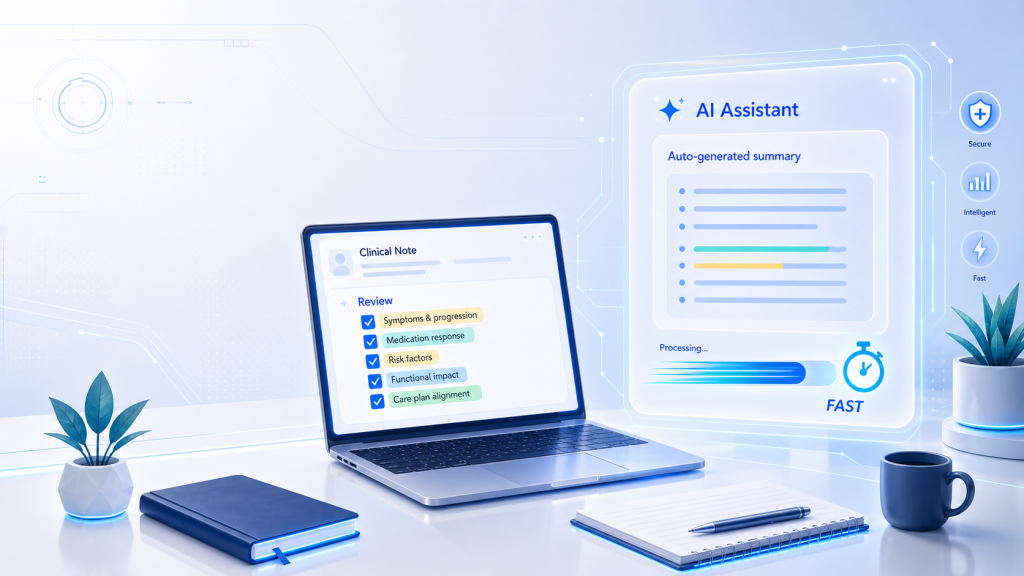
In a recent supervision session, a therapist shared her experience using AI to write notes and summaries. The output was quick and well-written. But when asked if it truly made her work feel easier, she paused. “It saves time,” she said, “but I still have to think just as much.” That hesitation reflects something many clinicians are starting to notice.
We often hear that AI will dramatically improve productivity. Some even suggest it could make work ten times faster. Yet in everyday clinical settings, the change feels more subtle. Speed may improve, but the depth of the work, understanding, deciding, staying present, remains just as demanding.
Part of this comes down to how we think about productivity. In clinical practice, it goes beyond getting things done quickly. It involves making sense of complex situations and applying thoughtful judgment. AI can support parts of the process, but it doesn’t replace the thinking behind it. Sometimes, it even creates a sense of rushing through decisions rather than sitting with them.
Engagement also plays a role. Gallup (a global analytics and advisory firm specializing in workplace research; State of the Global Workplace Report, 2023) reports that only 20% of employees worldwide feel engaged in their work. When many people are already feeling disconnected, introducing faster tools doesn’t necessarily improve the experience. It may simply make it easier to move through tasks without feeling more connected to them.
Motivation matters here. People tend to engage more when they feel a sense of purpose and ownership in what they do. When AI is introduced as a support for thinking, it can feel helpful. When it feels like another demand or shortcut, it can have the opposite effect.
Another important shift is in the type of effort required. Writing may take less time, but reviewing, checking, and adjusting often take more attention. The work doesn’t disappear, it changes shape. The cognitive load is still present, just redistributed.
The surrounding environment also makes a difference. When teams have space to reflect, ask questions, and learn how to use AI thoughtfully, the benefits are clearer. Without that support, AI can feel like an extra layer rather than a helpful tool.
There’s also the question of what happens with the time saved. In many settings, it quickly fills up with more tasks. This can leave people feeling just as rushed as before. A more intentional approach might use some of that time for reflection, learning, or improving care.
Ethical considerations remain central. AI can produce outputs that sound confident but may contain inaccuracies or bias. This makes careful review essential. Responsibility for decisions and content always stays with the clinician.
Overall, the impact of AI depends less on the tool itself and more on how it’s used. When approached thoughtfully, it can support clearer thinking and better workflows. The goal isn’t just to move faster, but to work with more clarity, care, and intention.
Gallup. (2023). State of the global workplace: 2023 report. Gallup, Inc.