
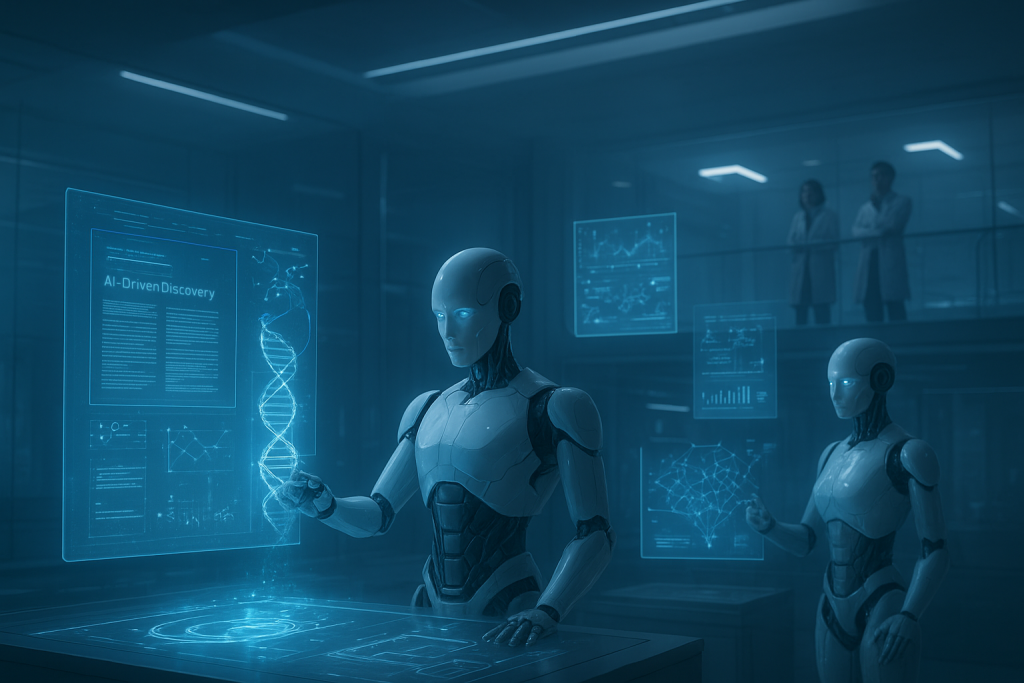
The pace of artificial intelligence advancement has been staggering, but OpenAI’s latest announcement marks a turning point that could redefine scientific discovery itself. By 2028, the company aims to develop fully autonomous AI researchers—systems capable of independently conceiving, executing, and refining entire scientific studies without human intervention. This isn’t merely an evolution of existing tools; it represents a fundamental shift in how knowledge is generated, one that promises to accelerate breakthroughs in fields ranging from neuroscience to education while forcing us to confront profound questions about the nature of research, authorship, and human expertise.
The implications for scientists, clinicians, and educators are immense. Imagine an AI that doesn’t just assist with data analysis but actively designs experiments based on gaps in current literature, adjusts methodologies in real-time as new evidence emerges, and publishes findings that push entire fields forward. For researchers drowning in the ever-expanding sea of academic papers, this could mean identifying meaningful patterns in days rather than years. Therapists might gain access to personalized intervention strategies derived from millions of case studies, while special educators could receive AI-generated instructional approaches tailored to individual learning profiles. Yet with these possibilities comes an urgent need to consider: How do we ensure these systems serve human needs rather than commercial interests? What happens when AI makes discoveries we can’t fully explain? And how do we maintain ethical standards when the researcher is an algorithm?
OpenAI’s roadmap to this future unfolds in deliberate stages, with the first major milestone arriving in 2026. By then, the company expects to deploy AI systems functioning as research interns—tools sophisticated enough to synthesize existing literature, propose testable hypotheses, and even draft experimental protocols with minimal human oversight. This intermediate step is crucial, as it allows the scientific community to adapt to AI collaboration before full autonomy becomes reality. The transition will require more than just technological advancement; it demands a cultural shift in how we view research. Peer review processes may need to evolve to accommodate AI-generated studies. Funding agencies might prioritize projects that leverage these tools effectively. And perhaps most importantly, researchers themselves will need to develop new skills—not just in using AI, but in critically evaluating its outputs, understanding its limitations, and ensuring its applications align with ethical principles.
The potential benefits are undeniable. In psychology, an autonomous AI researcher could analyze decades of therapy outcome data to identify which interventions work best for specific demographics, leading to more effective treatments. In special education, it might design and test personalized learning strategies for students with unique cognitive profiles, offering educators evidence-based approaches they previously lacked. Even in fundamental science, AI could accelerate the pace of discovery by running thousands of virtual experiments in the time it takes a human lab to complete one. Yet these advantages come with significant risks. Without careful oversight, AI systems could perpetuate biases present in existing data, overlook nuanced human factors that don’t fit neat statistical patterns, or even generate findings that appear valid but lack real-world applicability. The challenge, then, isn’t just building these systems—but building them responsibly.
As we stand on the brink of this new era, the scientific community faces a critical choice. We can approach this transition reactively, waiting to address problems as they arise, or we can take a proactive stance, establishing guidelines, ethical frameworks, and validation processes now. The latter approach requires collaboration across disciplines—computer scientists working with ethicists, clinicians partnering with AI developers, and educators helping shape how these tools integrate into real-world practice. It also demands public engagement, as the implications extend far beyond academia. When AI begins making discoveries that affect healthcare, education, and policy, who decides how those findings are used? The answers to these questions will determine whether this technological leap empowers humanity or leaves us struggling to keep up with machines that outpace our understanding.
Ultimately, the rise of autonomous AI researchers isn’t just about faster science—it’s about redefining what research means in an age where human and machine intelligence intertwine. The goal shouldn’t be to replace human researchers, but to create a synergy where AI handles the heavy lifting of data and computation while humans bring creativity, ethical judgment, and real-world insight. If we navigate this transition thoughtfully, we could unlock a new golden age of discovery—one where the most pressing questions in psychology, education, and medicine find answers at an unprecedented pace. But if we fail to prepare, we risk creating a system where the pursuit of knowledge outpaces our ability to use it wisely. The clock is ticking; 2028 is closer than it seems, and the time to shape this future is now.