
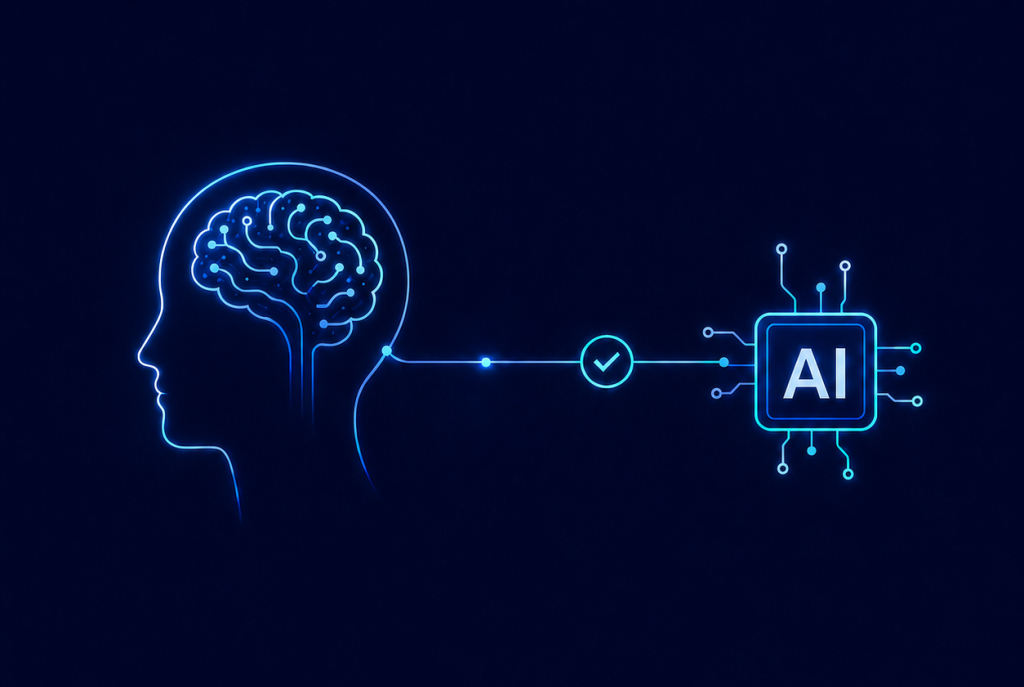
Une étude expérimentale récente a examiné comment des outils comme ChatGPT influencent la pensée pendant l'écriture Kosmyna, N. et al. (2025), conduite à MIT Media Lab, explore comment des outils comme ChatGPT influencent la pensée humaine pendant les tâches d'écriture. L'étude, intitulée "Votre cerveau sur ChatGPT: Accumulation de dettes cognitives lors de l'utilisation d'un assistant d'intelligence artificielle pour la tâche d'écriture d'essais," a examiné comment différents niveaux d'aide technologique façonnent l'engagement cognitif.
Les chercheurs ont recruté des participants et les ont divisés en trois groupes : l'un utilisant un assistant de l'IA (groupe LLM), l'autre utilisant un moteur de recherche et l'autre ne comptant que sur leur propre pensée (groupe Brain-Only). Au cours de trois séances, chaque groupe a utilisé la même méthode. Lors d'une quatrième session, les rôles ont été inversés pour certains participants : ceux qui avaient utilisé l'IA ont été invités à travailler sans elle (LLM-to-Brain), tandis que ceux qui avaient travaillé de façon indépendante ont été présentés à l'IA (Brain-to-LLM). L'étude a combiné les enregistrements du cerveau de l'EEG, l'analyse du langage, la notation des essais et les entrevues avec les participants pour comprendre non seulement la performance, mais aussi les processus cognitifs sous-jacents.
Les résultats montrent des différences évidentes dans la façon dont les participants se sont engagés sur le plan cognitif. L'activité cérébrale, mesurée par la connectivité neuronale, était la plus forte dans le groupe Cerveau seulement, modérée dans le groupe Search Engine et la plus faible dans le groupe LLM. Cela suggère qu'à mesure que le soutien externe augmente, l'engagement cognitif interne diminue. En parallèle, l'analyse linguistique a révélé que les essais réalisés avec l'IA étaient plus semblables les uns aux autres, montrant moins de variations dans le vocabulaire et la structure, tandis que les essais écrits indépendants étaient plus divers et distincts.
Les expériences des participants reflétaient également ces différences. Les membres du groupe LLM ont fait état d'un moindre sentiment de propriété sur leurs essais et ont eu plus de difficulté à se rappeler ou à citer ce qu'ils venaient d'écrire. En revanche, le groupe Cerveau seulement a montré un fort souvenir et un sentiment clair que le travail leur appartenait. Même lorsque les essais assistés par l'IA ont bien marqué, ils ont souvent exigé un montage minimal et sont restés proches des réponses par défaut générées par l'IA, ce qui indique des niveaux inférieurs de traitement actif.
La quatrième session a fourni quelques-uns des points de vue les plus importants. Les participants qui sont passés de Cerveau seulement à l'utilisation de l'IA (Brain-to-LLM) ont montré une connectivité cérébrale accrue dans plusieurs bandes de fréquences, suggérant une intégration active du soutien de l'IA avec des connaissances antérieures. Ils ont également bien fonctionné en termes de mémoire et de structure. Cependant, ceux qui sont passés de l'utilisation de l'IA à l'écriture indépendante (LLM-to-Brain) ont montré une diminution de l'engagement neuronal et ne sont pas revenus au même niveau d'activité cognitive que le groupe Cerveau seulement original. Leur écriture a également montré des traces de vocabulaire et de structure influencés par l'IA, indiquant un effet persistant de l'utilisation antérieure de l'IA.
D'un point de vue clinique, ces résultats sont très pertinents. Le raisonnement clinique dépend de l'engagement actif, de l'organisation de l'information, de l'établissement de liens et de la réflexion sur les décisions. L'écriture est l'une des principales façons pour les cliniciens de développer et d'affiner ce raisonnement. Si l'IA réduit la nécessité de cet effort, en particulier au début de la formation, cela peut conduire à ce qui peut être décrit comme dette cognitive: un affaiblissement progressif des processus de pensée qui soutiennent le jugement clinique.
Dans le même temps, l'étude suggère que l'IA peut être bénéfique lorsqu'elle est utilisée après l'établissement d'une pensée indépendante. Le groupe Brain-to-LLM a démontré que l'engagement préalable peut permettre aux cliniciens ou aux étudiants d'utiliser l'IA de façon plus intégrée et plus réfléchie. Cela s'harmonise avec les modèles éducatifs et cliniques où les outils de soutien sont les plus efficaces lorsqu'ils s'appuient sur une fondation existante plutôt que de la remplacer.
Ces résultats font également écho à la pratique clinique quotidienne. Les thérapeutes soulignent souvent l'importance de la participation active et de la réflexion chez les patients. De même, les cliniciens eux-mêmes s'appuient sur une pensée répétée et efficace pour acquérir une expertise. Si les outils d'IA commencent à remplacer plutôt que de soutenir ce processus, il peut y avoir des changements subtils mais significatifs dans la façon dont les cliniciens pensent, se souviennent et prennent des décisions.
Les implications éthiques sont importantes. Les cliniciens restent responsables de leur raisonnement et de leur documentation, même en cas d'IA. La diminution de la participation perçue soulève des préoccupations quant à la réduction de l'engagement critique. Si un clinicien se sent moins lié à ce qu'il a écrit, il peut être moins susceptible de l'interroger. On s'inquiète aussi davantage des préjugés et de l'exactitude, car le contenu généré par l'IA ne correspond pas toujours aux contextes individuels des patients ou aux considérations culturelles.
Pour les chercheurs et les étudiants, des risques similaires s'appliquent. L'écriture de haute qualité n'est pas seulement une question de clarté, mais de compréhension. Si l'IA aide à produire du texte sans engagement profond, il y a un risque de créer un travail qui semble fort mais manque de compréhension véritable. Le maintien de l'intégrité intellectuelle exige une participation active au processus de réflexion, et pas seulement à la production finale.
Dans l'ensemble, cette étude offre une perspective précoce importante sur la façon dont les outils d'IA comme ChatGPT peuvent façonner la cognition au fil du temps. Pour les cliniciens et les thérapeutes, il souligne la nécessité d'une approche équilibrée, qui utilise l'IA comme support tout en préservant la pensée efficace qui sous-tend l'expertise clinique. L'objectif n'est pas d'éviter ces outils, mais de les utiliser de manière à renforcer, plutôt que de remplacer, les processus cognitifs au cœur de l'apprentissage et de la pratique.