
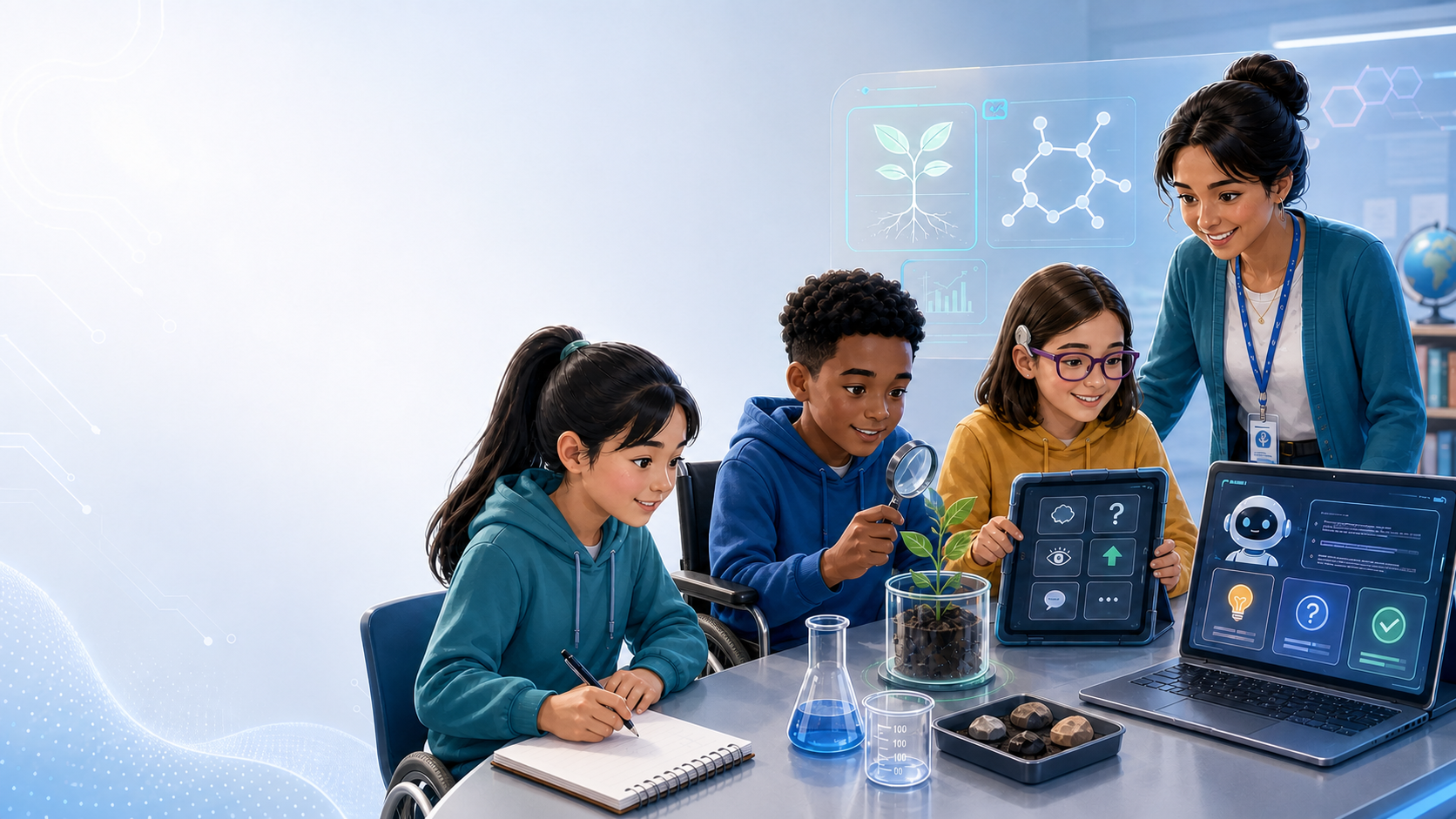
In inclusive classrooms, teachers and therapists carefully consider how to support each student. Some students need simpler language, more time or help organising information. However, support should also give students opportunities to ask questions, make choices and take an active role in learning.
Generative artificial intelligence, or GenAI, is a technology that can create text and respond to questions. ChatGPT is one example. It may help students understand difficult ideas, find information and explore topics that interest them. However, its value depends not only on the answers it provides, but also on whether it helps students become more involved in their learning.
A recent study published in the British Journal of Educational Technology by Rappa et al. (2026), titled “Can Generative AI Support the Learning Agency of Students with Disability? A Case Study of an Australian Secondary School,” explored this issue in a secondary science classroom. Three students with disability used ChatGPT while learning about gravity, friction, car brakes and motion. The researchers examined how students used the tool, what choices they made and what challenges they experienced.
The study focused on learning agency. In simple terms, this means having the opportunity and ability to take part in decisions about learning. A student may choose to ask a question or request a simpler explanation, but may still need support with communication, attention, memory or planning.
The students used ChatGPT in different ways. Arthur used it to learn more about gravity because he was already interested in science. Inez connected science ideas with real-life concerns, especially road safety. Louis asked science questions but also treated ChatGPT as a conversation partner. These examples show that students may use AI to make learning more meaningful and personal.
However, choosing to use ChatGPT did not always mean that students could use it independently. Some found it difficult to write clear questions, understand long answers or decide whether information was correct. Teachers therefore modelled how to ask questions, request simpler explanations and ask for examples. This kind of support is similar to the scaffolding used in therapy and education.
The findings suggest that GenAI may support students’ participation, but it does not replace human support. Teachers, therapists and education assistants may help students create questions, understand responses and connect AI information with classroom activities. The goal should be to build independence gradually, rather than simply giving students access to technology.
There are also important limitations. Only three students from one Australian school were included, so the findings cannot represent all students with disability. More research is needed with larger groups, different subjects and students with more significant communication or learning needs.
Ethically, professionals must consider privacy, accuracy and bias. Students should not enter personal information into AI systems. ChatGPT can provide incorrect or confusing answers, so adults must check its responses carefully. Students should also learn that AI can be useful, but it can make mistakes.
In the end, GenAI does not create learning independence by itself. It may support learning agency when it helps students ask questions, explore interests and make choices about learning. For therapists and educators, AI should be used as an additional support, not as a replacement for professional judgement, relationships or communication.
Reference
Rappa, N. A., Nonis, K. P., Tang, K.-S., Cooper, G., Cooper, M., & Sims, C. (2026). Can generative AI support the learning agency of students with disability? A case study of an Australian secondary school. British Journal of Educational Technology. https://doi.org/10.1111/bjet.70048