
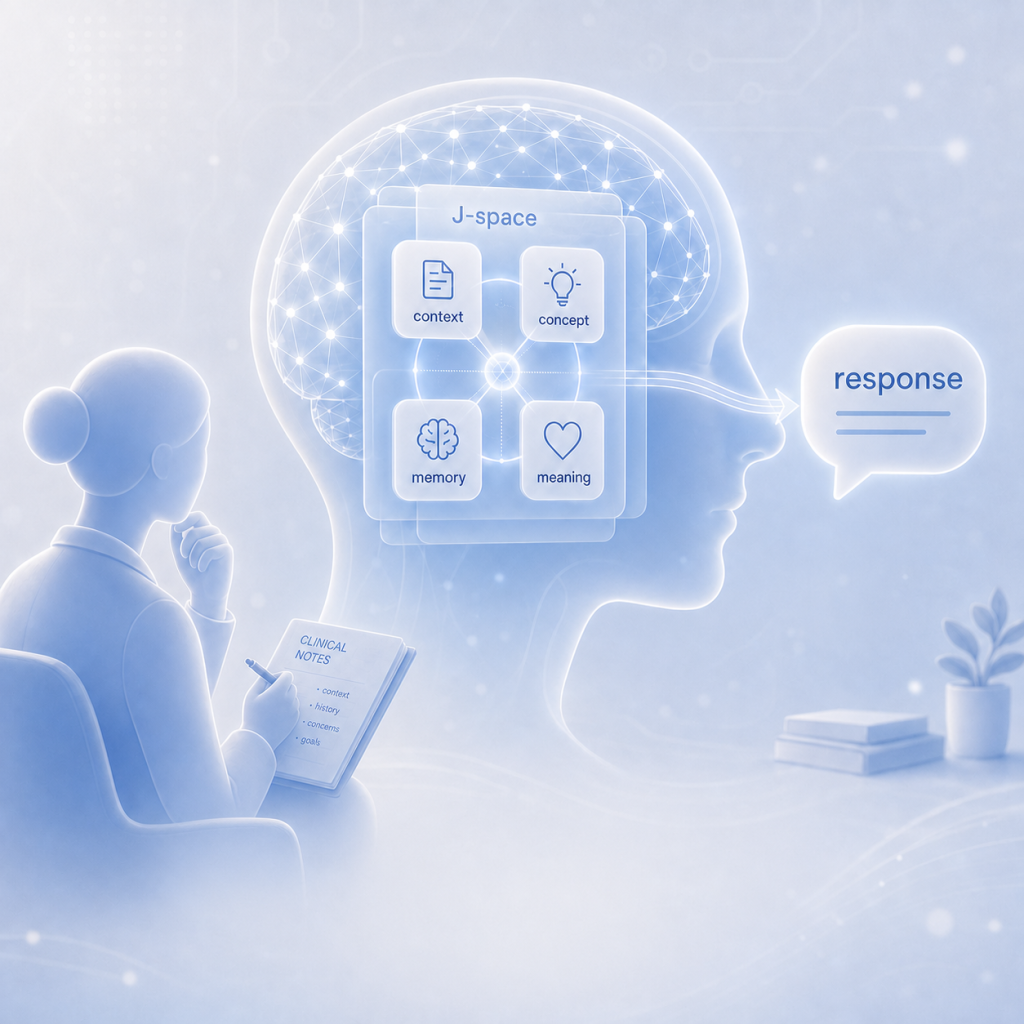
In clinical work, we often think before we speak. A therapist may listen, consider a few possibilities, and only then respond. Much of this thinking remains invisible. Researchers at Anthropic recently described something similar in their AI system, Claude: an internal space called “J-space,” where the model briefly holds and works with ideas before producing an answer.
J-space can be understood as a small mental workspace. It is not physical, but a pattern where important concepts are gathered and used. This idea is similar to what psychologists call a “global workspace,” where selected information becomes available for reasoning. In both humans and AI, thinking depends not just on knowledge, but on how that knowledge is organized in the moment.
A simple example helps clarify this. Claude was asked about “the animal that spins webs.” Internally, the concept “spider” became active, leading to the correct answer: eight legs. When researchers replaced that internal concept with “ant,” the answer changed to six. This suggests that the AI forms an internal idea first, which then guides its response.
For therapists, this process feels familiar. We often hold a working hypothesis in mind before speaking. These internal steps are essential, even if they are not visible. Importantly, when researchers reduced the influence of J-space, Claude still produced fluent language, but its reasoning became less accurate. This reminds us that clear or confident speech does not always reflect sound thinking.
At the same time, we should be careful with this comparison. AI systems do not understand in the human sense. Their internal patterns come from data, not lived experience. While the idea of a “workspace” is helpful, it is still a simplified description of a complex system.
For research, J-space offers a new way to study how AI reaches its answers. It may help identify errors, biases, or hidden signals, such as when a model detects misleading input. In clinical contexts, this could support decision-making, especially in complex cases—but it does not replace professional judgment.
There are also important limits. These findings are early and mostly tested in specific models. We do not yet know how consistent or stable this feature is. Future systems may also become harder to interpret, not easier.
Ethically, this raises questions about trust and responsibility. If clinicians use AI tools, they remain accountable for decisions. Internal signals like those in J-space should not be treated as fully reliable evidence. Transparency must include recognizing uncertainty and avoiding overconfidence in systems we do not fully understand.
In the end, J-space does not prove that AI “thinks” like humans, but it highlights something important: reasoning often depends on hidden steps. For clinicians, this is already familiar. What is new is the chance to observe a similar process in machines, which may deepen how we reflect on both human and artificial thinking.