
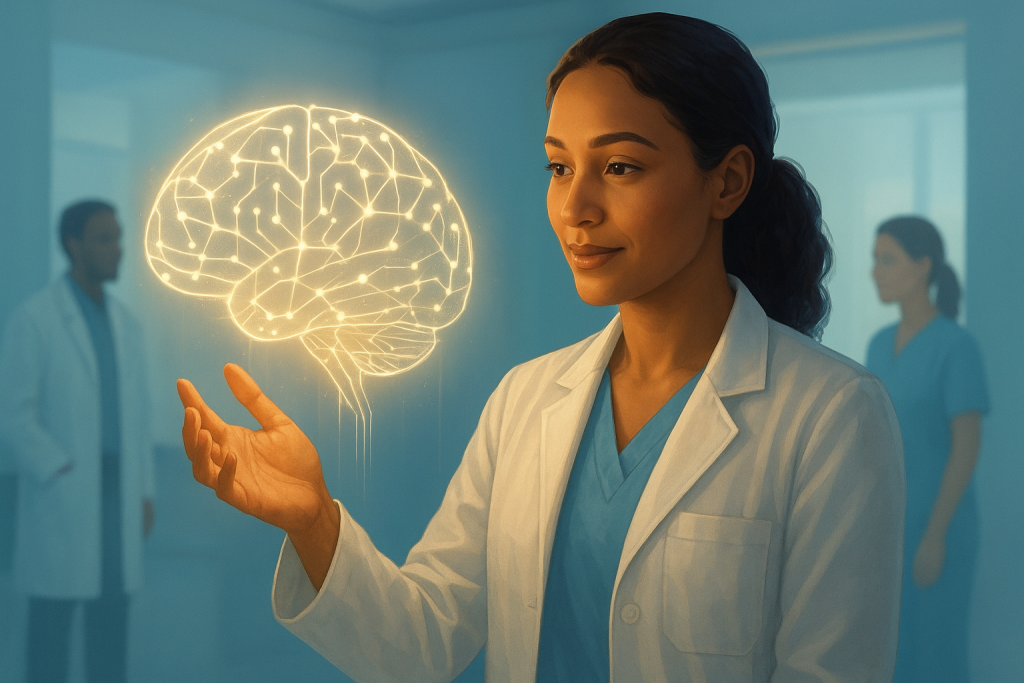
What if artificial intelligence could read your thoughts — not to spy on you, but to heal your brain? It may sound like science fiction, yet emerging research in brain-computer interfaces (BCIs) powered by AI is rapidly reshaping possibilities for people with paralysis, speech loss, or severe trauma. For professionals working in therapy, special education, and neuroscience, this isn’t just a technologic novelty — it signals a fundamental change in how we might approach intervention, autonomy, and recovery.
Decoding the Brain: How BCIs and AI Work
At their core, BCIs translate neural activity into digital commands. Historically, these devices captured signals (via EEG, implanted electrodes or minimally-invasive sensors) that corresponded with a user’s intention — like moving a cursor or selecting a letter. The leap now comes from AI. Sophisticated machine-learning and deep-neural-network models can decode nuanced brain patterns, adjust in real time, and even predict states such as mood shifts or seizure events. For example, a man with partial paralysis used a non-invasive BCI-AI hybrid system to control a robotic arm and complete screen-based tasks four times more effectively than with the device alone.
This is not automation—it’s collaboration. The AI decodes the signal, but the human leads the intention. As a practitioner, it means thinking of BCIs not as “devices we deliver to clients” but as extensions of the therapeutic interface — neural input, meaningful output, and a feedback loop that connects brain to device, device to action, and action to meaning.
Breakthroughs in 2024-25: From Paralysis to Restoration
Recent stories illustrate the pace of change. A 2025 article reported how a man with paralysis controlled a robotic arm via thought alone, thanks to an AI-enhanced BCI. Another major milestone: the company Medtronic’s BrainSense Adaptive Deep Brain Stimulation system — a closed-loop BCI-informed therapy for Parkinson’s — was named one of TIME’s “Best Inventions of 2025” after more than 1,000 patients received the treatment.
These examples aren’t just about technology; they’re about therapy delivered at the brain level. Speech therapists, neurorehabilitation professionals, and educators who support motor recovery might soon interact with clients whose therapy includes neural-interface elements: devices that decode intention, guide movement, or translate thought into speech. For many clients, the promise of regained autonomy—typing messages, controlling assistive devices, or even walking—becomes real.
Ethical and Practical Considerations for Clinical Practice
Despite the excitement, the shift from novelty to mainstream carries enormous responsibility. Data from neural interfaces is intensely personal: thinking, intending, perhaps even emoting. Decoding inner speech raises privacy questions. One recent implant study could interpret a user’s “inner monologue” with up to 74% accuracy. As clinicians or educators, we must ask: how do we preserve dignity, agency, and consent when the very channel of thought becomes part of therapy?
Accessibility is another concern. These technologies are highly specialist, invasive in certain cases, and expensive. Without careful integration, we risk creating a two-tier system where only some clients benefit. The research commentary on BCIs in 2025 notes that despite dramatic advances, many devices still require frequent recalibration and remain confined to labs.
From a practice standpoint, we’re entering the era of hybrid therapy—one where neural devices, AI analytics, and human relational expertise converge. Our role expands: we’re interpreters of neural data, ethical stewards of device use, and guides of clients whose therapy includes machine-mediated experience. The therapeutic alliance doesn’t disappear—it deepens.
For therapists, special educators and researchers, the rise of AI-enabled BCIs signals three shifts:
- Intervention scope expands: Therapy isn’t only behavior or function—neural recovery becomes a target.
- Data-rich practice: Continuous neural feedback offers insight into engagement, fatigue and brain-state changes in real time.
- Ethical foresight imperative: As technology enters the brain, ethical literacy becomes core professional competency, not optional.
In effect, the future of rehabilitation and intervention may involve thought, device, and context in tandem—with the human at the centre, but AI and BCIs as powerful allies.
While fully mainstream neurotechnology may still be a few years away, the trajectory is clear. We might soon design therapy plans that include neural intention measurement, adaptive devices that respond to brain-states, and home-based neural support systems. For now, staying informed, curious and ethically grounded is vital. When the channel of change is the brain itself, our practice must become correspondingly profound.
Suggested Reading:
- Nature (2025): A paralyzed man controls a robotic arm with his thoughts
- MedTech Insights (2025): BrainSense adaptive stimulation for Parkinson’s
Live Science (2025): The new implant that can decode inner speech