
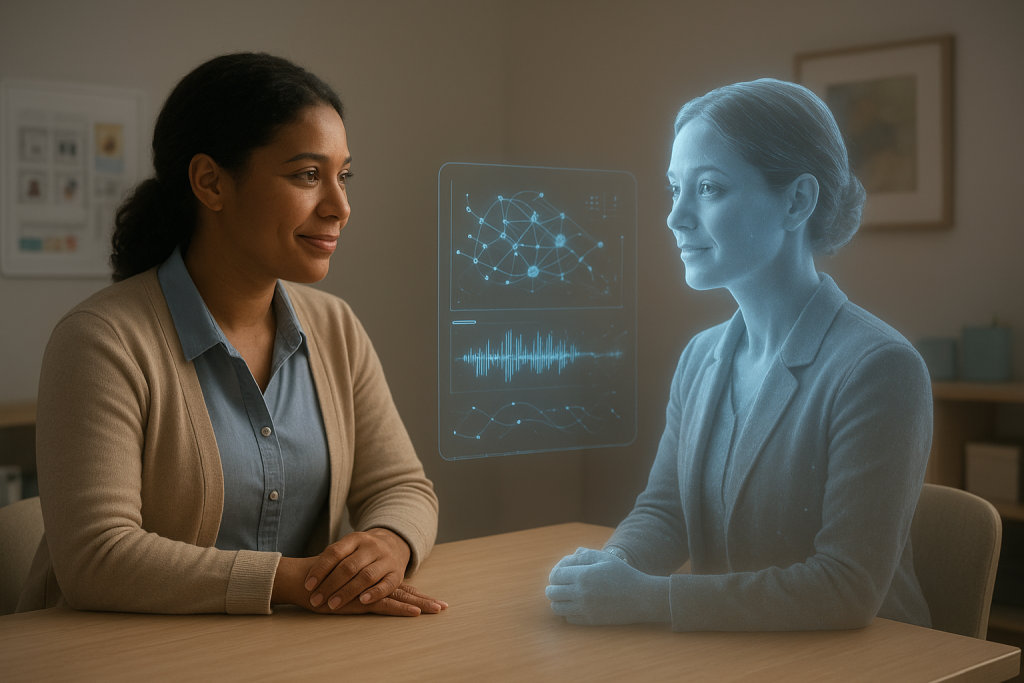
AI-generated video has evolved rapidly, but Tavus.io represents one of the most significant leaps forward — not just for marketing or content creation, but for human-centered practice. Tavus blends generative video with conversational AI, allowing users to create lifelike “AI Humans” that look, speak, and respond like a real person in real time. For those working in therapy, rehabilitation, special education, or health research, this technology raises fascinating possibilities for connection, continuity, and support.
Tavus allows anyone to create a digital version of themselves through a short video recording. Using advanced video synthesis, voice replication, and a real-time conversational engine, the AI Human can then deliver personalized information, respond to questions, and maintain natural back-and-forth dialogue. What makes Tavus stand out is how convincingly human these interactions feel — lip movement, tone, micro-expressions, pauses, and even warmth are remarkably well replicated. This is not a scripted avatar reading from a prompt; it is a dynamic, adaptive system that can hold a conversation.
One of Tavus’s most compelling aspects is its emotional presence. Many AI tools can generate text or voice, but Tavus adds the visual and relational layer that therapists and educators often rely on. For a child who struggles with attention, for example, seeing a familiar face explain a task may be more engaging than audio instructions. For families who need consistent psychoeducation, a therapist’s AI Human could walk them through routines, home-practice exercises, or behavior strategies between sessions. The technology does not replace real therapeutic interaction — but it can extend the sense of continuity and personalize support beyond the scheduled hour.
The platform also sits at an interesting intersection between accessibility and scalability. Many clinicians struggle with the time demands of creating individualized resources, recording educational videos, or maintaining consistent follow-up. With Tavus, a digital replica could produce tailored reminders, explain therapy steps, or offer instructional modeling without requiring clinicians to film new content every time. For special educators, this could mean creating personalized visual instructions for students who depend on repetition and predictability. For researchers, Tavus opens the door to standardized yet naturalistic video administration in cognitive or behavioral studies, improving consistency across participants.
Still, these new capabilities demand careful consideration. Cloning a clinician’s face and voice brings ethical questions around consent, identity, and professional boundaries. Researchers and clinicians must be transparent about how their AI Human is used, who interacts with it, and what data is collected. There are also relational concerns. If a client forms attachment to a therapist’s AI replica, how does that affect the therapeutic alliance? How do we prevent misunderstandings about the difference between a human clinician and a digital representation? The emotional realism that makes Tavus promising is the same realism that requires thoughtful guardrails.
From a research perspective, Tavus’s real-time conversational API is particularly noteworthy. Developers can train the AI Human on specific data — therapeutic principles, educational content, or institutional guidelines — and embed it into apps or web platforms. This could lead to new ways of delivering self-guided interventions, early identification of needs, or structured conversational practice for individuals with social communication challenges. The ability to scale personalized video support across thousands of learners or clients is unprecedented.
Yet Tavus’s potential is not only in delivering information, but in reinforcing the human behind the message. The system captures the familiarity of a clinician’s face, voice, and demeanor — something text-based AI cannot do. Used responsibly, this could strengthen engagement, increase retention in treatment programs, and support individuals who need more frequent visual prompting or reassurance.
Tavus is not a replacement for therapy. It is a new modality of communication — one that blends human presence with AI scalability. For many clinicians and educators, the question is no longer “Is this coming?” but “How should we use it well?” As AI video continues to evolve, Tavus offers a glimpse of a future where digital tools feel less mechanical and more relational, giving professionals new ways to extend care, reinforce learning, and bridge gaps outside the therapy room.
Suggested Reading
Explore Tavus.io: https://www.tavus.io
VEED x Tavus Partnership Overview: https://www.veed.io/learn/veed-and-tavus-partnership
Tavus API Documentation: https://docs.tavus.io/sections/video/overview