
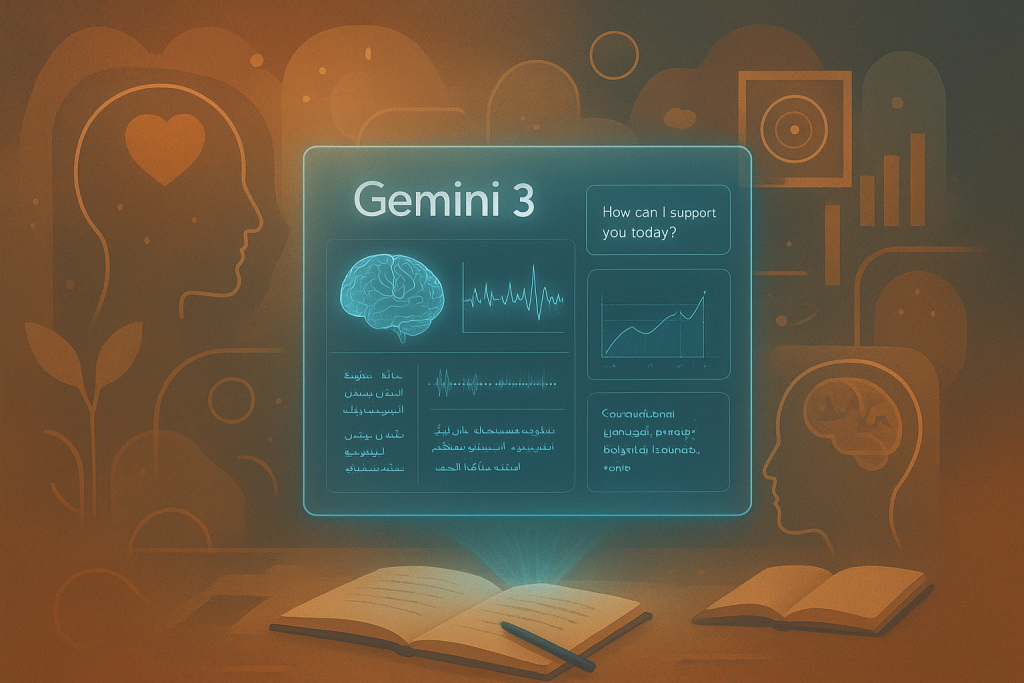
Every year, AI pushes a little further into territory we once believed required exclusively human cognition: nuance, empathy, reasoning, and adaptability. But with Google’s release of Gemini 3, something feels different. This new generation isn’t just another model update—it’s a shift toward AI that reasons more coherently, communicates more naturally, and integrates into clinical, educational, and research ecosystems with unprecedented fluency.
To many of us working in the therapeutic world, Gemini 3 arrives at a time when we are juggling increasing caseloads, administrative pressure, and the need for more adaptive tools that support—not replace—our expertise. And surprisingly, this model feels like a thoughtful response to that reality.
What Gemini 3 Actually Is — Beyond the Marketing
Google positions Gemini 3 as its most advanced multimodal model: text, audio, images, video, graphs, code, and real-time interactions all feed into one system. But what stands out is its improved reasoning consistency. Earlier models, including Gemini 1.5 and 2.0, impressed on benchmarks but sometimes struggled in long, structured tasks or therapeutic-style communication. Gemini 3 shows noticeable refinement.
It handles complex, layered prompts with fewer errors. It sustains long conversations without losing context. And perhaps most relevant to us—it is more sensitive to tone and intention. When you ask for a parent-friendly explanation of auditory processing disorder, or a trauma-informed classroom strategy, or a neutral summary of recent research, its responses feel less generic and more aligned with clinical communication standards.
Google also introduced stronger multilingual performance, something particularly important for our multilingual therapy and school settings. Gemini 3 processes Arabic, French, and South Asian languages with far greater stability than earlier iterations. For families and educators working in diverse linguistic communities, this matters.
How It Could Support Real Practice — From Our Perspective
I’ll be honest: when AI companies announce new models, my first reaction is usually cautious curiosity. “Show me how this helps in a real therapy room.” With Gemini 3, I’m beginning to see practical pathways.
In our therapeutic and educational contexts, the model’s improvements could enhance practice in several ways:
1. More Accurate Support for Clinical Writing
Gemini 3 feels significantly more reliable in structuring reports, generating progress summaries, and translating clinical findings into clear, digestible language. For many clinicians, writing takes as much time as therapy itself. A model that reduces cognitive load without compromising accuracy genuinely matters.
2. Better Tools for Psychoeducation
One of its strengths is tone adaptability. You can request information written for a parent with limited health literacy, a teacher seeking intervention strategies, or a teenager trying to understand their diagnosis. The explanations sound more natural, less robotic, and more respectful—qualities essential in psychoeducation.
3. Enhanced Use in Research and Evidence Synthesis
The model’s ability to handle long documents and produce structured, conceptually accurate summaries makes literature reviews, protocol design, and thematic analysis far more manageable. For students, researchers, and clinicians engaged in EBP, this can be a real asset.
4. A Potential Co-Facilitator for Learning & Rehabilitation
Gemini 3 can generate adaptive tasks, scaffold instructions, model social scripts, or create visual-supported routines. While no AI can replace human therapeutic presence, it can extend learning between sessions and increase engagement—especially for children, neurodivergent learners, and individuals needing high repetition.
5. More Reliable Multimodal Reasoning
Therapists often rely on materials—videos, images, diagrams, routines—to support learning. Gemini 3’s improved image analysis and video interpretation could help clinicians create resources faster and with greater clarity.
But Here’s the Real Question: Should We Be Excited or Cautious?
As therapists, we always stand with one foot in innovation and one firmly in safety. With Gemini 3, that stance remains essential.
The excitement comes from its ability to improve access, reduce overwhelm, and support families who need more than a once-a-week session. But caution is necessary because the more “human-like” the model becomes, the easier it is for users to over-trust its authority. Gemini 3 can sound empathetic—but it does not understand emotions. It can synthesize research—but it cannot replace clinical judgment.
The path forward, I believe, is intentional integration. We use Gemini 3 to enhance—not overshadow—our expertise. We let it support the labor-intensive parts of practice while ensuring interpretation and decision-making remain firmly human. And we maintain transparency with our clients, students, and families about where AI fits into our work.
Why Gemini 3 Matters Now
We are entering a period where AI tools are no longer optional—they’re becoming part of the professional landscape. What differentiates Gemini 3 is not its novelty, but its maturity. It offers enough stability, depth, and flexibility to genuinely support practice, without the erratic unpredictability that marked earlier generations.
For therapists, special educators, and researchers, Gemini 3 represents an opportunity to reclaim time, enhance personalization, and deepen our capacity to deliver care. But it also invites us to reflect thoughtfully on our role in this changing ecosystem: to lead the conversation on ethical integration, to train the next generation in AI literacy, and to ensure technology remains a tool of empowerment rather than replacement.
The future of therapy is still human-centered. Gemini 3 simply gives us more room to keep it that way.