
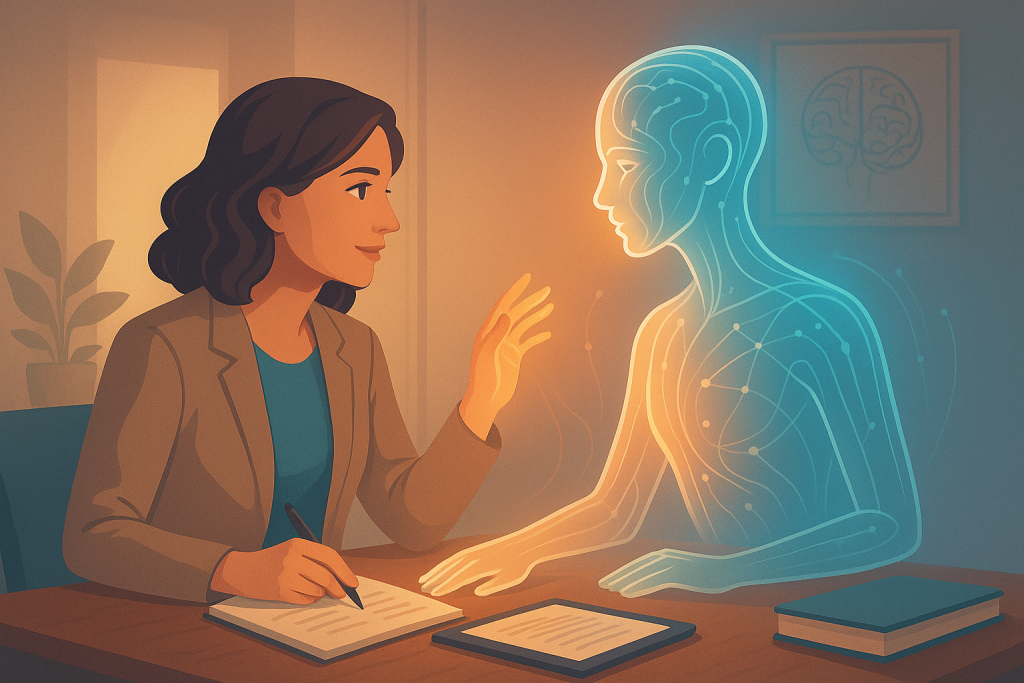
If you’ve been using ChatGPT for a while, you may have noticed something this month — it suddenly feels different. Warmer. Sharper. A bit more… human. That’s not by accident. On November 12, 2025, OpenAI officially rolled out ChatGPT 5.1, and this update quietly marks one of the biggest shifts in how we’ll work with AI in clinical, educational, and research settings.
I’ve spent the past week experimenting with it across therapy planning, academic analysis, and content design. What struck me wasn’t just the improved accuracy — it was the way the AI “holds” a conversation now. It feels less like querying a machine and more like collaborating with a knowledgeable colleague who adapts their tone and depth depending on what you need.
This isn’t hype — it’s architecture. And it’s worth understanding what changed, because these changes matter deeply for practice.
A New Kind of AI: Adaptive, Expressive, and Surprisingly Human
The GPT-5.1 update introduces two new model behaviors that genuinely shift its usefulness:
1. GPT-5.1 Instant — the “human-sounding” one
This version focuses on tone, warmth, responsiveness, and emotional contour. It’s designed to carry natural dialogue without feeling rigid or scripted. As OpenAI describes, it’s built to “feel more intuitive and expressive.”
2. GPT-5.1 Thinking — the analytical one
This variant does something no GPT model has done before: it thinks longer when it needs to, and responds more quickly when it doesn’t.
This is huge. It means the model adjusts its cognitive workload similar to how we do — slowing down for complex reasoning, speeding up for routine tasks.
OpenAI confirmed these changes improve performance across logic, math, coding, and multi-step reasoning tasks. That adaptability makes GPT-5.1 closer to a genuine cognitive partner rather than a question-answer tool.
Tone Control: The Feature That Changes Everything
GPT-5.1 introduces eight personality presets (Professional, Friendly, Candid, Quirky, Nerdy, Cynical, Efficient, and Default), plus experimental sliders that let you control:
- Warmth
- Conciseness
- Humor
- Emoji usage
- Structure (more narrative vs more scannable)
For clinicians and researchers, this means we can now shape AI output according to purpose:
a psychoeducation script for a parent meeting needs a different “voice” than a research synthesis or a therapy report.
This level of control may be one of the most important steps toward making AI genuinely usable in sensitive, human-centered fields.
Where GPT-5.1 Actually Changes Practice
After testing it across multiple settings, three shifts stand out to me:
1. Therapy Planning Feels More Collaborative
GPT-5.1 Instant produces conversational prompts, social stories, cognitive-behavioral scripts, and session ideas in a tone that feels usable with real clients. Not clinical. Not robotic. Not formal.
Just human enough.
2. Academic and Clinical Writing Becomes Faster and Cleaner
The Thinking model handles literature synthesis more coherently, drills down into conceptual frameworks, and maintains clarity even in longer analytical passages.
As someone juggling multiple academic roles, this is a dramatic improvement.
3. Research Navigation Becomes Less Overwhelming
GPT-5.1 is noticeably better at connecting theories, comparing methodologies, and explaining statistical models. It’s not replacing critical thinking — but it absolutely accelerates it.
This matters because research literacy is increasingly becoming a prerequisite for ethical practice.
Not Everything Is Perfect — And That’s Important to Say
With more expressive language, ChatGPT 5.1 sometimes leans into over-articulation. Responses can be too polished or too long. That may sound like a small complaint, but in therapy or medical contexts, excess wording can dilute precision.
There’s also the bigger ethical reality:
the more human these models feel, the easier it is to forget that they are not human.
GPT-5.1 may sound empathetic, but it does not experience empathy.
It may sound thoughtful, but it does not truly understand.
It may draft clinical notes beautifully, but it cannot replace judgment.
In other words: GPT-5.1 is a powerful partner — as long as the human stays in charge.
Where We Go From Here
What I find most encouraging is that GPT-5.1 feels like a model designed with professionals in mind. It respects tone. It respects nuance. It understands that not all tasks are equal — some require speed, others require depth.
For those of us working in therapy, education, psychology, neuroscience, and research, this update provides something we’ve needed for a long time:
A tool that can meet us where we are, adapt to what we need, and amplify — not replace — our expertise.
ChatGPT 5.1 doesn’t just make AI stronger.
It makes it more usable.
And that’s a turning point.
Sources
- OpenAI. GPT-5.1 Release Notes & Feature Overview (2025). https://openai.com/index/gpt-5-1/
- MacRumors Tech News. ChatGPT 5.1 Announced With Warmer Tone and New Personality Modes (2025).
- eWeek. OpenAI Releases GPT-5.1 With Adaptive Reasoning Improvements (2025).
- Stanford HAI commentary on evolving reasoning in large language models (2024–2025).