Répertoire de prompts cliniques – IA générative pour thérapeutes

- Description
- Curriculum
- Reviews

Ce répertoire de prompts cliniques est conçu pour accompagner les thérapeutes et les professionnels de l’accompagnement dans un usage structuré de l’intelligence artificielle générative. Il propose des exemples de prompts directement adaptables à la pratique clinique, pédagogique et organisationnelle, notamment pour la création de matériel.
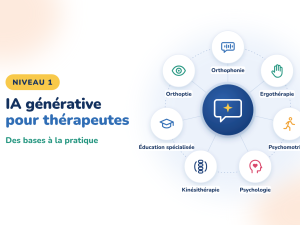
Il s’adresse aux orthophonistes, ergothérapeutes, psychologues, neuropsychologues, psychomotriciens, éducateurs spécialisés et autres professionnels du soin, de la rééducation, de l’éducation ou de l’inclusion.
Le répertoire est actuellement disponible en français ; la version anglaise paraîtra prochainement.
Sommaire
Chapitre 1 – Fondements de l’intelligence artificielle générative
- Introduction à l’intelligence artificielle
- IA, apprentissage automatique et IA générative : repères essentiels
- Fonctionnement général de l’IA générative
- L’IA générative dans les pratiques thérapeutiques aujourd’hui
- Le rôle du thérapeute face à l’IA générative
Chapitre 2 – Fondamentaux du prompt : ingénierie des requêtes
- Qu’est-ce qu’un prompt ?
- Optimiser les prompts : une approche itérative
- Erreurs fréquentes dans l’usage des prompts en pratique thérapeutique
- Principales techniques d’ingénierie de prompt
- Limites et cadre d’utilisation de l’ingénierie de prompt en contexte thérapeutique
Chapitre 3 – Répertoire de prompts cliniques
- Enfants de 3 à 12 ans : langage oral ; communication et compétences sociales ; fluence de la parole (bégaiement, débit, initiation de la parole)
- Adolescents de 12 à 18 ans : mémoire, attention et fonctions exécutives ; cognition sociale et régulation émotionnelle ; langage écrit (lexique, lecture, orthographe, rédaction) ; prompts de motivation et d’engagement
- Adultes (AVC, aphasie et troubles neurofonctionnels) : trouble neurocognitif d’étiologie vasculaire, post-AVC, avec aphasie ; troubles cognitifs associés aux troubles neurocognitifs d’étiologies vasculaire, traumatique et neurodégénérative ; dysphagie oropharyngée ; troubles de la voix
Chapitre 4 – Conclusion
This clinical prompt book helps therapists and support professionals use generative AI in a structured way. It offers prompt examples that can be adapted directly to clinical, educational and organisational practice, especially for creating therapy materials.
It is intended for speech-language pathologists, occupational therapists, psychologists, neuropsychologists, psychomotor therapists, special educators and other professionals in care, rehabilitation, education or inclusion.
The Prompt Book is currently available in French. An English edition is coming soon.
Contents
Chapter 1 – Foundations of generative AI
- Introduction to artificial intelligence
- AI, machine learning and generative AI: key concepts
- How generative AI works
- Generative AI in therapeutic practice today
- The therapist’s role in the age of generative AI
Chapter 2 – Prompt fundamentals: prompt engineering
- What is a prompt?
- Optimising prompts: an iterative approach
- Common prompting mistakes in therapeutic practice
- Main prompt engineering techniques
- Limits and framework for prompt engineering in therapeutic contexts
Chapter 3 – Clinical prompt library
- Children aged 3 to 12: oral language; communication and social skills; speech fluency (stuttering, rate, speech initiation)
- Adolescents aged 12 to 18: memory, attention and executive functions; social cognition and emotional regulation; written language (vocabulary, reading, spelling, writing); motivation and engagement prompts
- Adults (stroke, aphasia and neurofunctional disorders): vascular neurocognitive disorder, post-stroke, with aphasia; cognitive disorders associated with vascular, traumatic and neurodegenerative neurocognitive disorders; oropharyngeal dysphagia; voice disorders
Chapter 4 – Conclusion